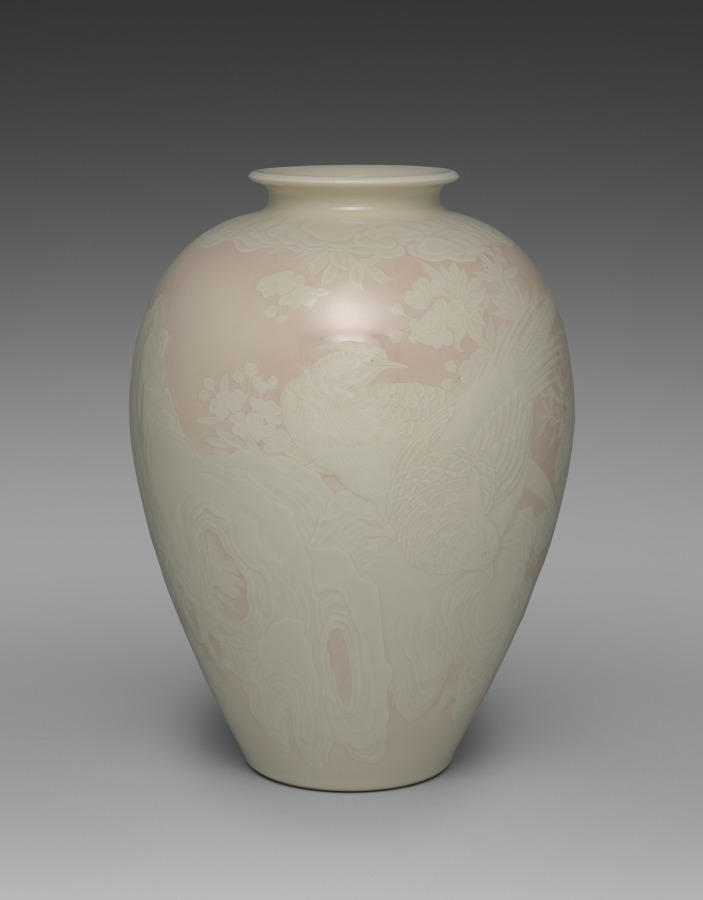
Like the design of Flower Vase with Phoenix in Paulownia (CMA 2022.199), the pair of pheasants in a dramatic landscape setting on this vase was created by adding clay to the surface of the clay body and then molding and carving it. Here, instead of a typical white clay, Yohei III has used an ivory clay. He then added gradated pink around the complex design, which with its multitude of cherry blossoms must have been painstaking to mask with precision. For the birds’ eyes, he added a touch of yellow. He then fired the vase with an allover translucent cream glaze. The resulting kanpakuji piece is one in which an academic subject long favored by painters of the Kano school for screen and sliding door paintings in important buildings, that of impressively sized birds within a scene of precipitous, angled rock faces and twisting trees, is made soft and ethereal while retaining a sense of gravitas.
View the original at Cleveland Museum of Art →Article 3 tells libraries what to gather, and the list is wider than books: local materials, local administrative records, works of art, records and film. Article 3 also requires interlibrary lending, travelling collections and mobile libraries, so that the holdings move toward the reader rather than waiting.
The cool part. Article 17 is one sentence and admits nothing. A public library may not collect an admission fee, or any consideration whatsoever, for the use of library materials. Free is not a policy that a budget round can revisit, it is the statute. Article 26 is stranger still: the state and local authorities must not interfere in the work of a private library, and must not give it a subsidy. Independence is protected by withholding the money.
Verify at e-Gov 法令検索 →Use it Take the ratio, not the picture. It sets a page better than a grid does.
Description source: museum curator text — not generated