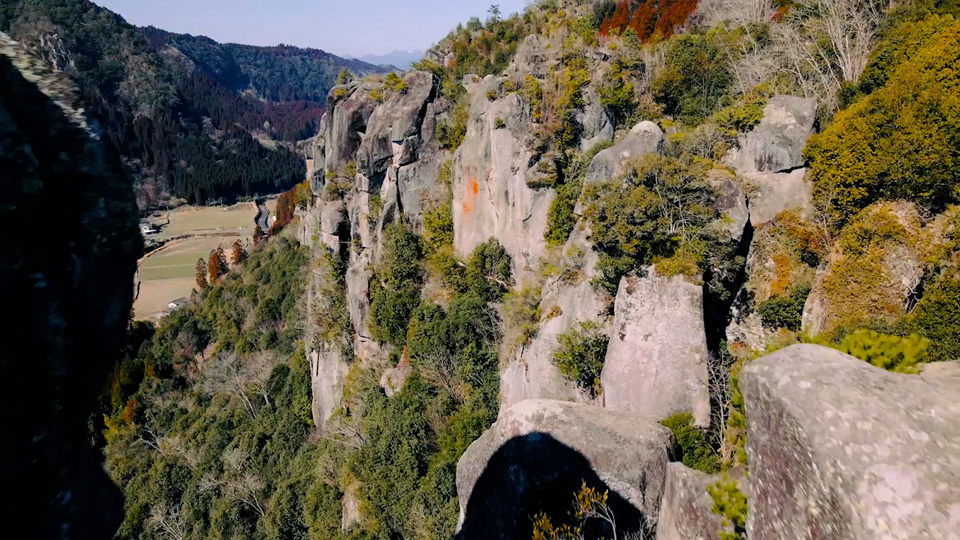
In the city of Nakatsu, in Oita Prefecture, Japan, there is a beautiful valley called "Yama-gawa Kei." This spacious area, with a size of approximately 32km north to south and 36km east to west, offers stunning views of vertical rock pillars, caves, waterfalls, and large boulders. For instance, there is a series of holes in the riverbed where rocks have rotated to form, the "Monkey Falls Thousand Pots Valley." In another place, a group of rock pillars encircles a scene reminiscent of the Eight Views of Hangzhou, called "One Glance Eight Scenes." Additionally, there is a 10km stretch of shallow rapids made of a single slab of rock, known as "Toyo-gawa Valley." Along the way, you can also discover remnants of old cycling roads and the "Old Toyo Forest Engine Shed." Enjoying the beautiful valley includes exploring these attractions. The mysterious landscape of Yama-gawa Kei has become a place of worship. Stone Buddhas have been placed in various caves. Temples, such as Rakan-ji, have been built into the rock walls. Within this temple belt, there are over three thousand stone statues. The space feels as if the stone Buddhas are living and practicing meditation. One of the oldest 500 Rakan stone Buddhas in Japan, which was carved around 1350, is a national important cultural asset.
大分県中津(なかつ)市と玖珠町には、「耶馬渓」という美しい渓谷があります。南北32km東西36kmの広い地域に、垂直に切り立った石の柱やほら穴、滝や巨石に天然の石橋など、驚きの光景が見られます。例えば、石が回転してできた穴が川底に連続する「猿飛千壺峡」、石柱群にぐるりと囲まれる「一目(ひとめ)八景(はっけい)」、10km続く一枚岩の浅瀬を歩ける「大谷渓谷」などです。サイクリングロードとなっている線路跡や「旧豊後森機関庫」などの鉄道遺産をたどりながら美しい渓谷を楽しめます。 耶馬渓は、その神秘的な地形から祈りの場所にもなってきました。あちこちの洞穴には石仏がおさめられました。岩壁に埋め込まれるように建てられた「羅漢寺(らかんじ)」一帯には、三千体をこえる石像が置かれており、石仏たちが生きて修行をしているような空間となっています。なかでも約650年前に彫られた日本最古の五百(ごひゃく)羅漢(らかん)石仏(せきぶつ)は国の重要文化財です。岩をはい、鎖をつたい、たくさんの探勝道を探検できるのが耶馬渓の魅力です。
View the original at Japan Search →Article 1 states the purpose plainly: prevent trade in stolen goods, find them quickly, and speed the recovery of victims. Article 2 then defines a used article to include, in the same breath, art objects held for appreciation. Dealing in them requires a licence.
The cool part. Article 16 requires a dealer to record every transaction: the date, the item and quantity, its distinguishing features, and the address, name, occupation and age of the other party. Article 15 requires that a dealer who suspects an item is stolen report it to a police officer immediately. So the antique trade runs on a register the police may read, and a painting becomes a second-hand article the moment it has been used once.
Verify at e-Gov 法令検索 →Use it Two-colour foil on uncoated stock gets you most of this at production cost.
Description source: museum curator text, translated — not generated