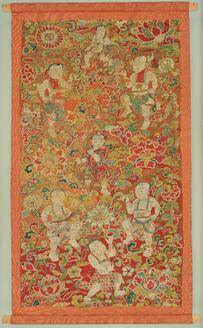
There is a fabric with the name "asagiri" which is filled with stitches so densely that it seems to cover every gap. This intricate stitching uses vivid colors such as red, blue, and yellow. It is a distinctive stitching technique from the ancient period. The design is attributed to a Chinese child, called "Tango," who longs for a child and is depicted in a symbol of good fortune.
隙間がある絽という絹地の網目を1つ1つ刺繡で埋め尽くすように刺繡を施した、大変手の込んだ裂です。赤や青、黄色など鮮やかな色彩を用いた明時代特有の刺繡技法です。「唐子」と呼ばれる中国の幼子がデザインされ、子宝を願う吉祥文様となっています。
View the original at Japan Search →Article 2 defines a museum as an institution that collects, keeps and displays materials on history, art, folklore, industry and natural science for public use, carries out research on them, and which has been registered under Chapter 2 of this Act. The registration is not decorative. In law, an unregistered collection open to the public is not a museum.
The cool part. The definition of keeping is given as including raising. That single parenthesis is why a zoo, an aquarium and a botanical garden sit inside museum law in Japan: the collection is allowed to be alive. Article 1 also grounds the statute in the Social Education Act and the Basic Act on Culture and the Arts, which places museums in education first and culture second.
Verify at e-Gov 法令検索 →Use it Two-colour foil on uncoated stock gets you most of this at production cost.
Description source: museum curator text, translated — not generated