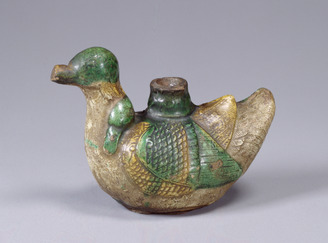
This is a pottery piece made in the southern part of China, commonly referred to as the "Han dynasty three colors" style. Its shape resembles that of a duck, and it is painted with yellow and green glazes, covering its body. The Han dynasty three colors were introduced to Japan as trading porcelain in the 16th century, and excavations have reported discoveries of such artifacts at Osaka Castle and other sites of Japanese feudal lords.
中国南部で焼かれた、いわゆる華南三彩の水注です。型成形で鴨のかたちにあらわし、黄色と緑の釉でからだを塗り分けています。華南三彩は16世紀に貿易陶磁として日本にもたらされ、首里城のほか、日本の戦国大名の館跡などからも出土が報告されています。
View the original at Japan Search →Article 1 gives three grounds for regulating a sign: forming good landscape, maintaining scenic character, and preventing danger to the public. Article 3 then lets a prefecture prohibit outdoor advertising outright, by ordinance, in named categories of place.
The cool part. Read the list in Article 3 and it stops being an advertising law. The places where signage can be banned include landscape districts, scenic districts, preservation districts for groups of traditional buildings, the surroundings of designated Important Cultural Properties, and historic sites, places of scenic beauty and natural monuments. The statute protects the view by removing the sentences written across it.
Verify at e-Gov 法令検索 →Use it Take the ratio, not the picture. It sets a page better than a grid does.
Description source: museum curator text, translated — not generated