Quiet reading✦No ads, ever

✦Corporate brand & media services✦Made in Virginia Beach since 1997✦

Huang Goodman · Art Forgotten

Art Forgotten

Art from public museum collections. A mismatched real Japanese law, and some other factoids.

Every object, image and description comes from the museum's own catalogue record, and every object links to its original. Japanese records are machine-translated into English; the museum's Japanese is kept beside the translation because it is the authoritative form. Each law carries its official number and links to e-Gov 法令検索, the Japanese government's statute database.

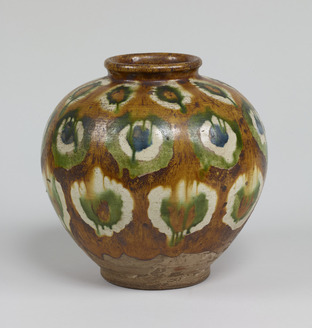
三彩壺
{三彩壺 · 東京国立博物館 · 唐時代・8世紀 / Tang dynasty, 8th century · Japan Search · 国立国会図書館}
Three-color Jar This catalog introduces a jar with a multi-layered glaze, displaying vibrant hues of red, yellow, and green. The piece exemplifies the traditional Japanese technique of "sanbaiyu," which translates to "three colors." Each layer of glaze is meticulously applied, allowing the subsequent color to peek through, creating an intriguing visual effect. The crafting of this jar is a testament to the artisan's skill and dedication to the age-old technique. The result is a stunning piece that showcases the beauty of Japanese ceramics. The three-color glaze is achieved through a specific firing process. The first layer of glaze is applied, then the jar is fired at a lower temperature. After cooling, the second layer is added and fired at a higher temperature, allowing the first layer to peek through, creating the striking contrast. This technique has been practiced for centuries in Japan, with various regions developing their unique styles and variations. The three-color effect adds depth and complexity to the otherwise simple form of a jar, making it a cherished addition to any collection. The beauty of the three-color jar lies not only in its visual appeal but also in the rich history and tradition behind it. Each piece is a testament to the enduring artistry and craftsmanship of Japanese ceramics.

This container boasts an unusual three-color representation. It was collected during the early Meiji period for a museum. Chinese ceramic.

文様表現が珍しい三彩壺。明治時代、博物館最初期に収蔵された中国陶磁。

View the original at Japan Search →
The law
美術品の美術館における公開の促進に関する法律
Act on Promotion of Public Exhibition of Works of Art in Museums
平成十年法律第九十九号 · Act No. 99 of 1998

A statute built to coax privately held work onto public walls. An owner registers a piece with the Commissioner for Cultural Affairs, then contracts with a museum to display it. Article 2 defines a work of art broadly, as paintings, sculpture, crafts and other tangible cultural products that are movable, which is the legal way of saying anything you could carry out of the house.

The cool part. The terms are the interesting part. Article 2 requires the public display contract to run for five years or more, and to contain a clause stating that the parties may not give notice of cancellation. You cannot lend a masterpiece for the tax treatment and then reclaim it when the market turns. Japan concluded the barrier to seeing art was never storage. It was ownership, and the fix was a contract you cannot walk out of.

Verify at e-Gov 法令検索 →

Use it The border is the idea. Use it as an edge treatment and leave the centre empty.

Description source: museum curator text, translated — not generated