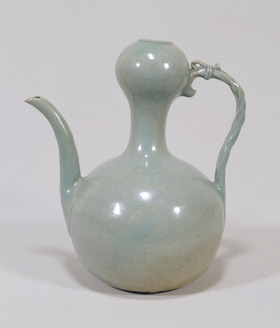
The deeply serene green-blue glaze color, the meticulous carving patterns, suggest the elegant style of the high Tang dynasty in Chinese porcelain. The bowl shape with a foot, is a prototype sought after in Chinese porcelain of the Northern Song dynasty, yet it reveals a sense of calm beauty contrasting the delicate forms of Chinese porcelain.
深く落ち着きのある青緑色の釉調、丁寧な彫り文様は高麗青磁最盛期の作風を示しています。承盤を伴う形式の水注は北宋時代の中国陶磁に祖型が求められますが、中国陶磁のきびきびとした造形に対して、おっとりとした高麗特有の美感があらわれています。
View the original at Japan Search →Article 1 sets a purpose larger than preservation: to preserve cultural properties AND to make use of them, contributing to the cultural advancement of the people and to the progress of world culture. Article 4 turns that outward. An owner must recognise the object as a precious national asset, preserve it for the public, and make it public as far as possible. Ownership here carries a duty to show.
The cool part. "Living National Treasure" appears nowhere in the statute. Article 71 requires that when an Important Intangible Cultural Property is designated, the minister must also certify its holder or holding group. Japan does not register the pot, it registers the potter. Article 96 is the one that reaches ordinary people: if you uncover a shell mound, a dwelling site or a tumulus, you must leave it exactly as it is and notify the Commissioner for Cultural Affairs without delay, and the Commissioner can freeze the ground for up to three months.
Verify at e-Gov 法令検索 →Use it A motif small enough to blind-deboss, which is where restraint actually shows.
Description source: museum curator text, translated — not generated