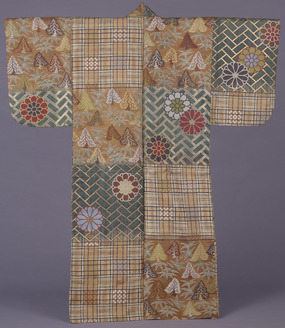
In order to give a clear impression from a distance, artisans often use changes of clothing for the costumes. In this area, the lattice segment and the segments of cedar, bamboo, and chrysanthemums are effectively arranged, creating a bright and lively impression. Among the thick-boarded brocades used as undergarments, those with raised ornaments are called elegant and ornate items.
遠目にもはっきりとした印象を与えるためであろう、能装束にはしばしば段替の意匠が用いられる。この一領では、格子の段と、杉・竹・菊の段が効果的に配され、明快な印象を与える。厚板唐織は内着として用いる厚板のうち、浮き織りを併用した華やかな品をいう。
View the original at Japan Search →A weapons statute that contains the most important art registry in the country. Article 2 defines a sword by measurement: a blade of fifteen centimetres or more for a sword, spear or naginata, five and a half for a dagger. Article 14 then carves out an exception. The prefectural board of education registers old firearms of value as art or antiques, and swords of value as art, on the basis of an appraisal by registration examiners appointed for their scholarly knowledge.
The cool part. A Japanese sword is lawful to own because it has been certified as art. Not because it was disarmed, not because it was licensed as a weapon. The judgement is made by the board of education, and Article 14 then requires the board to notify the prefectural public safety commission of what it has decided. The culture side rules, and the police are informed afterwards. Fail the appraisal and the same object becomes contraband.
Verify at e-Gov 法令検索 →Use it A motif small enough to blind-deboss, which is where restraint actually shows.
Description source: museum curator text, translated — not generated