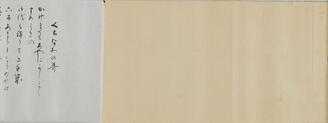
In November 15th, Showa year (around 1930), at the Tokyo Imperial Museum, there was a special exhibition of treasures from the Asakura Shrine. A crowded scene of this exhibition was drawn by an employee named Yoshikawa Nohana. The row of people can be seen extending from the end of Ueno Park where a bronze statue of the west imperial palace stands, with the Art Association, the Science Museum, and other prominent figures of the time becoming almost unrecognizable. "Kuchinawa" refers to a type of hebi (snake) skin. (April 25th, 2006 – June 25th)
昭和15年11月に東京帝室博物館で開催された正倉院御物特別展観の混雑ぶりを、職員の野間清六が描いたもの。行列は西郷隆盛銅像の立つ上野公園の端まで続いており、美術協会、科学博物館、両大師など当時の様子もうかがえる。「くちなわ」とはヘビの異名。(2006年4月25日~6月25日)
View the original at Japan Search →A statute built to coax privately held work onto public walls. An owner registers a piece with the Commissioner for Cultural Affairs, then contracts with a museum to display it. Article 2 defines a work of art broadly, as paintings, sculpture, crafts and other tangible cultural products that are movable, which is the legal way of saying anything you could carry out of the house.
The cool part. The terms are the interesting part. Article 2 requires the public display contract to run for five years or more, and to contain a clause stating that the parties may not give notice of cancellation. You cannot lend a masterpiece for the tax treatment and then reclaim it when the market turns. Japan concluded the barrier to seeing art was never storage. It was ownership, and the fix was a contract you cannot walk out of.
Verify at e-Gov 法令検索 →Use it A motif small enough to blind-deboss, which is where restraint actually shows.
Description source: museum curator text, translated — not generated