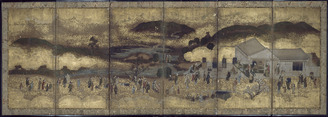
A tree with cherry blossoms on its right side has birdcages aligned. The feather colors and cawing sounds of the birds compete in this scene of "Kotori Awase" (Bird Gathering). On the left side, there is an autumn scene where dogs are made to bite each other for a contest called "Inu Awase" (Dog Gathering). Both sides depict the game of "Mono Awase" (Object Gathering), which was popular during the medieval period. The unusual screen painting that portrays these two events together provides a glimpse into how they were entertaining pastimes at the time.
桜の花咲く右隻に鳥籠が並べられているのは、羽毛の色や鳴き声の優劣を競う「小鳥合(ことりあわせ)」の様子を描いたもの。一方、左隻は秋の情景で、犬を噛み合わせて勝負させる「犬合(いぬあわせ)」である。いずれも「物合(ものあわせ)」と呼ばれる遊戯で、近世に広く行われたが、この両者をともに描く屏風作品は珍しい。続々と集まってくる人々の様子からは、こうしたイベントが当時いかに心躍る娯楽であったかがうかがわれる。
View the original at Japan Search →Article 1 describes the Ainu as the indigenous people of the northern part of the Japanese archipelago and of Hokkaido in particular, and cites international circumstances concerning indigenous peoples as a reason for acting. It requires the government to set a basic policy, and lets municipalities draw up regional plans for approval by the Prime Minister.
The cool part. The definition in Article 2 is the part to sit with. Ainu culture means the Ainu language, and the ways of living, music, dance, crafts and other cultural products inherited among the Ainu, and cultural products developed from these. That final clause refuses to freeze the culture at a date, and treats what is made next as equally the thing being protected. The Act then reaches into trademark law, reducing or waiving registration fees for regional collective trademarks used by approved projects.
Verify at e-Gov 法令検索 →Use it The border is the idea. Use it as an edge treatment and leave the centre empty.
Description source: museum curator text, translated — not generated