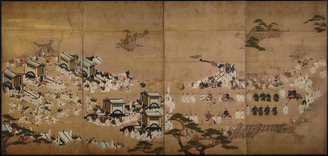
The room adjacent to Toyotomi Hideyoshi's quarters in the Kiyomachi Palace was newly built for his bride-to-be and her groom. The scene depicted in the sliding doors of this building is from the "Genji Monogatari" (Tale of Genji), specifically the part where the circular configuration portrays a chaotic scene. Due to this masterpiece, Yarikawa gained the trust and protection of the Kiyomachi family. The screen consists of four panels. The right half shows a neat procession of people and horses, but the left half is disordered with people and cattle carriages (gishya) colliding. What is happening there? This scene is from the "Genji Monogatari." The most prominent figure on the right panel, riding a splendid black horse, is Genji himself. The scene takes place at the Kamogawa Shrine in Kyoto. People have gathered here to witness the beautiful appearance of Genji, who is participating in the Kamonomatsuri festival. The three cattle carriages in the lower left part of the second panel, which seem to obstruct Genji's procession, are actually those of Genji's sister, Murasaki, and her attendants. They attempted to move their carriages, causing a commotion. In fact, there was a carriage from the Miya-su-no-miyasudokoro (the sixteenth night) among them. The quarrel over the viewing site was caused by the two women arguing over Genji.
豊臣秀吉の側室淀殿が、嫁ぐ養女の完子と新郎のために新築した九条御殿の襖絵で引手跡がみえる。『源氏物語』の葵の上と六条御息所の行列見物の場所争い。乱闘場面を表わす円環状の構図が見事だ。この仕事で山楽は九条家から信頼され、庇護を受けることとなる。 4枚のパネルがつながった屏風です。右半分は人物や馬の行列が整然と進んでいますが、左半分は人や牛車(ぎっしゃ)が入り乱れ、混乱した様子です。何が起こっているのでしょうか。 これは「源氏物語」の一場面です。一番右のパネル、立派な黒い馬に乗り、ひときわ目立っているのが光源氏(ひかるげんじ)です。ここは京都の賀茂神社。賀茂祭(かものまつり)の行列に参加する光源氏の晴れ晴れしい姿を見るために、人びとが集まっています。 左から二番目のパネルの下、光源氏の行列をさえぎるように並ぶ3台の牛車は、源氏の正妻、葵の上の一行です。後から来たにもかかわらず、すでに集まっていたほかの牛車を立ち退かせようとしたため、お供の者たちがもみ合って乱闘になっています。実はこの中に、源氏と恋愛関係にあった六条御息所(ろくじょうのみやすどころ)の牛車がありました。見物場所の争いは、光源氏をめぐる二人の女性の争いになってしまったわけです。 今は屏風の形になっていますが、よく見ると、もともと襖絵であったことを示す、引手の跡があります。屏風に仕立てられた際に切り縮められた部分があったのでしょうか、各パネルの絵がつながらないところもあります。もとは、もう少し横にゆったりとした配置だったのでしょう。 作者の狩野山楽は、はるか昔の物語なのに、見物人たちの姿を新しい同時代の装いに変えて描きました。屏風を見た人びとには、現実感あふれる、生き生きとした場面にうつったことでしょう。
View the original at Japan Search →A national statute written for one city. Article 1 recites the beauty of Kyoto and its historically, culturally and artistically important position in the world, and gives two purposes: to raise international culture and serve the ideal of permanent world peace, and to contribute to the economic recovery of Japan. It was passed five years after the war ended.
The cool part. Article 3 lets Kyoto designate culture tourism preservation districts and, by ordinance, prohibit building, rebuilding, removal, changes to the shape of the land and the cutting of bamboo, trees and stone, with compensation for ordinary loss. Then Article 4 does something statutes almost never do. It places a duty on the mayor personally: in the spirit of local autonomy, and with the cooperation of residents, the mayor must engage in ceaseless activity to complete the city. Nara received its own Act, number 250, the day before.
Verify at e-Gov 法令検索 →Use it Palette for a single-colour run: one ink, heavy stock, nothing else on the sheet.
Description source: museum curator text, translated — not generated