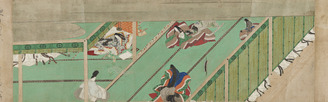
A story about a nobleman named Sagoromono-chuujo from the Asuka period, and his younger sister, Genji-no-miya, who is also depicted in the tale of Genji Monogatari. The artwork is an invaluable example from the Kamakura period that matches the scenes in a scroll. The delicate drawing, colors, and calligraphy suggest that it could have been created during the Muromachi period. The Tale of Sagoromono Monogatari, which was established during the Heian period, primarily focuses on the romantic history of Sagoromono-chuujo. Part of this artwork is preserved at the Tokyo National Museum, along with a fragment of the same scroll that was later owned by the Tokugawa shogunate. The beginning of the scroll depicts the tragic love story between Genji-no-miya and Sagoromono-chuujo. Genji-no-miya yearns to become the empress, and Sagoromono-chuujo visits her residence, hoping to convey his feelings. However, she rejects him after seeing an illustration from the Tale of Ise Monogatari. Sagoromono-chuujo is left heartbroken, but later meets and falls in love with the woman he saves on the road, Asuka-hime-gimi. The structures and ornaments depicted in the artwork reflect the daily life of the Heian aristocracy.
狭衣中将という才色兼備の貴公子と、幼い頃よりともに育てられた従妹・源氏宮の悲恋を描く物語を絵画化したもの。本作は鎌倉時代に制作された絵巻に場面が一致する貴重な作例。丁寧な描写や彩色、書風などから、その制作は室町時代にさかのぼる可能性がある。 狭衣物語(さごろもものがたり)は、平安時代(11世紀)に成立した物語で、かつては源氏物語(げんじものがたり)と並び称されました。狭衣中将(さごろものちゅうじょう)という才色兼備の貴公子の恋愛遍歴を主に描いています。東京国立博物館には、鎌倉時代(14世紀)につくられ、のちに徳川将軍家が所有していた同絵巻の断簡も収蔵されています。 この絵巻は物語の冒頭部分で、従妹の源氏宮(げんじのみや)との悲恋を描いたものです。源氏宮が皇太子の妃に望まれていると聞き、狭衣は焦る気持ちで彼女の住まいを訪ねます。伊勢物語(いせものがたり)の絵を見ていた源氏宮の手を取り、恋心を伝えますが、恋は実りませんでした。傷心の狭衣は、その後、道中たまたま助けた女性、飛鳥井姫君(あすかいのひめぎみ)と結ばれます。 絵の中の建物のつくりや調度品には、平安貴族たちの暮らしぶりが再現されています。たとえば、先ほどの源氏宮邸で恋心を伝える場面。丸い柱は平安時代の貴族の邸宅である寝殿造(しんでんづくり)の特徴の一つです。また、障子(しょうじ)には桜が、やまと絵の技法で描かれています。日本の風景を描いたやまと絵は、貴族の邸宅の調度として平安時代以降好まれました。こうした平安王朝文化に憧れ、懐かしむ気持ちを込め、鎌倉時代以降に制作されたと考えられます。
View the original at Japan Search →Article 2 defines a museum as an institution that collects, keeps and displays materials on history, art, folklore, industry and natural science for public use, carries out research on them, and which has been registered under Chapter 2 of this Act. The registration is not decorative. In law, an unregistered collection open to the public is not a museum.
The cool part. The definition of keeping is given as including raising. That single parenthesis is why a zoo, an aquarium and a botanical garden sit inside museum law in Japan: the collection is allowed to be alive. Article 1 also grounds the statute in the Social Education Act and the Basic Act on Culture and the Arts, which places museums in education first and culture second.
Verify at e-Gov 法令検索 →Use it Palette for a single-colour run: one ink, heavy stock, nothing else on the sheet.
Description source: museum curator text, translated — not generated