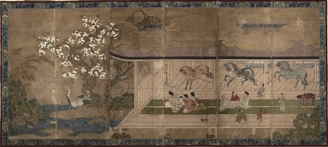
Two screens facing each other display a scene of six horses connected to a stable (uma-ya). The horses on the right are calmly connected, but the ones on the left raise their legs in lively leaps. Horses with powerful beauty have often been motifs in paintings, representing authority. However, it is unclear who created this screen, or what meanings are conveyed. The horses are used in equestrian arts, but they might also be divine horses, drawn for some wish. Looking closely, there are various people gathered around the stable. It seems they are playing various board games. The right screen depicts go, and the left screen depicts shogi and sugoroku. There are also people sleeping, carrying tea, and intently watching the horses. Each person's relationship and the overall scene are unclear. A dog appears on the right screen, and a monkey on the left. Monkeys are often considered stable guardians, and horses and monkeys are often depicted together. Dogs might have been used in hunting, such as falconry, with horses. Interestingly, landscapes outside the stable are depicted at both ends. On the right, there are pines, wisteria, white herons, and turtles. On the left, there are cherry trees, willows, cranes, and mandarin ducks. Both sides feature auspicious motifs. People enjoying go, shogi, and sugoroku are seen in front of the stable, along with dogs and monkeys.
左右一対の屏風を連続した画面にして、厩(うまや)につながれた6頭の馬を描いています。 むかって右の3頭はおとなしくつながれていますが、左の3頭は脚を跳ね上げた躍動感あふれる馬です。名馬の力強く美しい姿は、権威の象徴としてしばしば絵画のモチーフになりました。しかし、この屏風について、どんな人が作らせたのか、どんな意味がこめられているのか、実はあまりよくわかっていません。この馬たちは武芸用の馬で、その美しい姿を愛でたものかもしれませんし、あるいは神馬で、なにか願いをこめて描かれたのかもしれません。 よく見ると、厩には様々な人が集まっています。どうやら様々なボードゲームを楽しんでいる様子。むかって右の屏風では囲碁、左の屏風では将棋と双六(すごろく)で遊んでいます。そのほかにも、寝そべっている人、茶を運んでいる人、馬をじっと見ている人などがいますが、それぞれがどんな関係で、画面全体ではどんな場面を表わしているのか、よくわかっていません。 さらに、右の屏風には犬、左の屏風には猿が登場します。猿は厩の守り神とされ、しばしば馬とセットで描かれます。犬は、もしもこれらの馬が武芸用だとすると、鷹狩りなどの際に馬とともに使われたものかもしれません。 さらに興味深いのは、屏風の両端に描かれた厩の外の風景です。右は、松に藤、白鷺と亀、左には桜に柳、鶴と鴛鴦(おしどり)。いずれも吉祥のモチーフをちりばめた風景が描かれています。 厩舎に繋がれた六頭の馬を中心に、その前には囲碁、将棋、双六に興じる人々、犬や猿も見えます。屋外には右隻に松、藤、鷺、亀、左隻に桜、柳、鶴、鴛鴦など、おめでたい動植物も添えられています。馬は富の象徴でもあり、多くの馬を描いた屏風は室町時代に流行しました。 きゅうしゃ、いご、しょうぎ、すごろく、さぎ、おしどり
View the original at Japan Search →Unusually for a Japanese statute it opens with a preamble, which states that finding joy in creating culture and living among it is an unchanging wish of people, and that culture contributes to world peace. Article 2 then sets the principles: the autonomy of those who make culture must be fully respected, and their creativity, standing and capacity considered.
The cool part. Article 2, paragraph 3 is the line worth reading twice. It says that creating and receiving culture is a right people are born with, and requires an environment in which citizens can appreciate, participate and create regardless of age, disability, economic situation, or the area they live in. Four barriers named in statute, one of which is your postcode. It puts the arts in the same grammatical register as infrastructure. Not a subsidy argued for each year, a standing obligation.
Verify at e-Gov 法令検索 →Use it Two-colour foil on uncoated stock gets you most of this at production cost.
Description source: museum curator text, translated — not generated