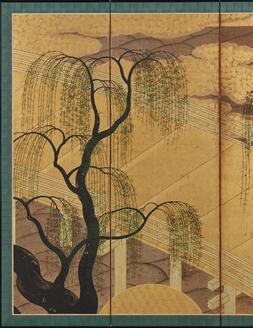
A bridge arching over a river, adorned with vivid golden decorations, has water wheels and bamboo cages on its surface. On the right side of the painting, a moon appears, making it clear that this artwork depicts the Uji Bridge over the Uji River in Kyoto. Uji is historically known as a beautiful place associated with the Emperor Seiwa. Both screens are a set. The bridge is depicted with calm, winding curves on both screens. Surrounding the bridge are willow trees. On the left screen, a water wheel and a cage are visible at the left edge. This cage is called a "jakago," which is used to prevent erosion by filling it with stones. Both screens have a lattice pattern made by filling the lattice holes with shell powder and powdered charcoal, creating a golden color while maintaining a three-dimensional appearance. Willows and the bridge represent Kyoto's Uji Bridge. Since Uji is a famous moon-viewing spot, it is likely that this river is Uji River. The sky on the right screen contains a moon. Besides the moon, the white froth on the water's surface originally shone silver. The overall color scheme is golden, but there is no presence of people. The calm, still water and clouds, as well as the representation of willows, create a serene, dreamlike landscape or an empty stage setting.
川に架(か)かる橋は、華やかな金箔で彩られ、水面には、水車や竹で編んだ蛇籠(じゃかご)が配される。画面の右には月が浮かび、それらのモチーフから、この絵が京都の宇治川に架かる宇治橋を描いていることがわかる。宇治は古来、景勝の地として知られている。 左右でセットの屏風です。右と左の屏風にわたって、ゆるやかなカーブを描く橋がかかっています。その周りには柳の木がしなだれかかります。左の屏風の左端には水車と籠が見えます。この籠は蛇籠(じゃかご)といって、護岸などのために籠に石を詰めて用いるものです。よく見ると右の屏風にも籠がみえますが、どれも貝の粉、胡粉を作って盛り上げて籠の網目模様を作っており、金色だけを使いながら立体的な表現をしています。 柳と橋は、京都の宇治橋を象徴するモチーフ。宇治は月の名所でもありますから、この川はおそらく宇治川でしょう。右の屏風の空には、月が出ています。月に加えて、川面の飛沫も、現在は黒くみえますが、描かれた当初は銀色に輝いていたことでしょう。全体に金色の色調の華やかな景色ですが、人の気配はありません。デザイン化された水や雲、柳の表現もあいまって、どこか夢の中の風景や、無人の舞台装置のようなおもむきもあります。屏風の前に立つと、そのまま画面のこちら側からわたっていけそうな大きさで橋が描かれています。川の流れを受けて回り続ける水車は、終わりない苦しみや輪廻をイメージさせる、仏教的なモチーフでもあります。華やかでありながらも、橋の向こう側にはあの世があり、いつかあちらに行けるかもしれない、そんな気持ちにもさせる、荘厳な雰囲気をたたえた屏風です。
View the original at Japan Search →Japan implementing the 1970 UNESCO Convention. When a foreign state reports that cultural property has been stolen from an institution, the Ministry of Foreign Affairs notifies the education ministry, which designates the object as specified foreign cultural property, after consulting the trade ministry. Importing a designated object then requires approval under the foreign exchange and trade law.
The cool part. Article 6 quietly rewrites private law. Under the Civil Code a good-faith purchaser is normally secure against a recovery claim after two years. For designated stolen foreign cultural property, the victim may demand recovery from two years after the theft until ten years have passed. Buying in good faith does not settle the question for a decade, which is roughly how long it takes a stolen object to surface on a legitimate market.
Verify at e-Gov 法令検索 →Use it Two-colour foil on uncoated stock gets you most of this at production cost.
Description source: museum curator text, translated — not generated