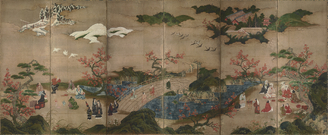
This screen painting, located in Kyoto's northern Higashiyama district at Takao, by the side of Clear Water Canal, depicts people enjoying the autumn leaves. On the right side of the screen, facing the painting, a group of women with children are seen enjoying tea and sake while enjoying the autumn foliage. On the bridge, there is a group of men blowing horns, with a monk leading a boy, trying to cross the bridge. The men on the left side of the wheel are dancing in rhythm, enjoying a banquet. In the depths of the cloud on the screen, there is a temple with a pagoda on the right, called Shinto Temple, and on the left, the arrival of winter is signaled by the snowy landscape of the Shitennoji Temple and its torii gate and approach. This screen painting vividly depicts the daily life and entertainment of the people during that time. Please enjoy the beauty of the autumn leaves and the lively scenes of people's enjoyment.
紅葉の名所として名高い京都洛北の高雄、清滝川のほとりで紅葉狩りを楽しむ人々を描いた屏風です。画面の向かって右側、川の手前では子供連れの女性が茶売りの茶や酒を飲んで紅葉をめでながら楽しいときを過ごしています。橋の上では一組の男性が笛を吹き、童子を伴った僧が、語らいながら橋を渡ろうとしています。左の輪になった男性の一群は、拍子をとりながら舞を舞い、酒宴に興じています。そして、画面中ほどにかかった雲の奥には、画面右に宝塔のある神護寺、左に冬の到来を告げる雪景色の愛宕社の鳥居と参道が描かれています。 当時の人々の衣食や芸能の様子を生き生きと描写した観楓図屏風。紅葉の美しさとともに、人々の楽しげな遊楽の様子をご覧ください。
View the original at Japan Search →Unusually for a Japanese statute it opens with a preamble, which states that finding joy in creating culture and living among it is an unchanging wish of people, and that culture contributes to world peace. Article 2 then sets the principles: the autonomy of those who make culture must be fully respected, and their creativity, standing and capacity considered.
The cool part. Article 2, paragraph 3 is the line worth reading twice. It says that creating and receiving culture is a right people are born with, and requires an environment in which citizens can appreciate, participate and create regardless of age, disability, economic situation, or the area they live in. Four barriers named in statute, one of which is your postcode. It puts the arts in the same grammatical register as infrastructure. Not a subsidy argued for each year, a standing obligation.
Verify at e-Gov 法令検索 →Use it A motif small enough to blind-deboss, which is where restraint actually shows.
Description source: museum curator text, translated — not generated