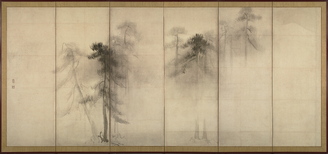
On a white Japanese paper, scenes of wind and light are depicted only through the varied thickness of ink. Up close, the needles of the pine tree seem to be compressed by the fierce brushstrokes. The pine tree that draws pine needles is believed to be one that has repeatedly dipped its brush in ink, ground bamboo to make it fine, or bundled bamboo. The delicate and intricate brushwork can be seen as the pine forest is progressively drawn. Four large groups of pine trees are depicted, arranged as if the wind was blowing through the gaps between them. Light and shadow are depicted through the gradation of ink, creating a foggy pine forest. A gentle light filters through the mist, revealing a distant snowy mountain, a cold and damp air drifting, and the scent of the wind and the forest. The artist Equilibrium, inspired by the traditional Japanese motif of pine trees, has depicted this scene using watercolor techniques learned from Chinese painting. The powerful brushwork and varied ink create a floating pine forest in the mist. Looking closely, do you not feel as if the mist is stirring, or the light is scattering, or the wind is whispering? The pine trees are meticulously drawn, but their true charm lies in the ability to feel the air of the scene in real life. This is why Japanese watercolor painting is considered its pinnacle.
白い和紙の上に墨の濃淡だけで、風と光の情景が描き出されています。画面に近づいて松の葉をみると、その激しい筆勢に押されて、後ずさりするくらいです。松を描く筆は、穂先をいくつも重ねたもの、竹の先を細かく砕いたもの、あるいは藁(わら)を束ねたものを使ったと考えられており、明らかではありません。繊細でありながら迷いなく筆を進め、一気に線を引いていることが見てとれます。離れてみると、松の幹はまるで能を舞うかのように風に揺られています。 四つほどの大きなグループに描かれた松林は、木々の間を風が通り抜けるように配置されています。そして、墨のグラデーションによって光の強弱をあらわして、霧に包まれた松林を生み出しているのです。 さまざまな工夫と技法によってあらわされたこの松林には、霧の晴れ間から柔らかな光が差し込んで、遠く雪山がのぞき、冷たく湿った空気が漂います。艶(つや)やかな墨の色と相まって、風の流れや森の清清しい香りまで実感できるでしょう。 等伯は松林という日本の伝統的なモティーフを、中国絵画から学んだ水墨表現によって描き出し、日本の風土の豊かな形象をみごとにあらわしているのです。 勢いのある筆の動きと墨(すみ)の濃淡だけで、靄(もや)のなかに浮かび上がる松林を表現しています。 じっと見ていると、立ち込める靄が動いたり、光がこぼれたり、ざわざわと風の音がしたりしませんか?松の木の形を緻密(ちみつ)に写すというよりは、その場の空気をリアルに感じられるところがこの作品の魅力、日本水墨画の最高峰といわれる理由です。 よく見ると、松林の奥には、遠く雪山が薄っすらと描かれています。季節は冬へと向かう晩秋でしょうか、それとも雪解けの春でしょうか。描かれたのは、等伯(とうはく)の故郷、能登半島の浜辺にある松林だという説もあれば、古くからの画題である天橋立(あまのはしだて)や、三保(みほ)の松原(まつばら)ではないかという説もあります。そのほかにも、この絵にはいくつかの謎が指摘されています。向かって右の屏風、右隻(うせき)の右端で切れた松が、左隻(させき)の左端に描かれた枝先につながっているように見えます。つまり、元は左右が逆だったのではないか。紙の継ぎ目が横一線につながらないことや、通常より粗末な紙を使っていることから、実は下絵だったのではないか。いやいや、それにしてはいい墨を使っている、など、研究者の間では様々な意見が出されています。もちろん正解はありません。見る人それぞれの感性で、それぞれの心の風景とリンクさせながら、じっくりと味わってみてください。 そこで、この絵を見るコツをひとつお教えします。屏風の前に立ったら少し前後に動いて、絵の中の地面と、自分の立っている床面とが重なるところを探してみてください。まるで絵の中の松林に入っていくかのように感じられるはずです。
View the original at Japan Search →A craft cannot call itself traditional by taste or reputation. Article 2 sets five conditions, all of which must hold: it is used mainly in daily life, the main part of its making is by hand, it is made by traditional techniques, it is made chiefly from materials traditionally used, and a not-small number of people in a defined area still make it. The designation names the techniques, the materials and the region.
The cool part. Two conditions do quiet work. The first is daily use, so a technique kept alive only for display does not qualify. The fifth is the number of makers: the law will not protect a single surviving genius, because one person is a biography and not an industry. And because the region is written into the designation, the craft is legally attached to a place and cannot move.
Verify at e-Gov 法令検索 →Use it The border is the idea. Use it as an edge treatment and leave the centre empty.
Description source: museum curator text, translated — not generated