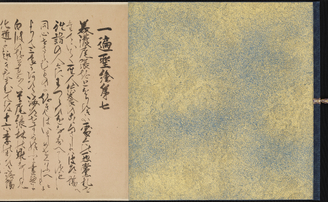
This "One Hundred Saints" scroll is about Jishu, the founder of the Jishu sect, who said that one could reach the Pure Land of Amida Buddha regardless of one's faith, as depicted in this illustrated scroll. Unusually, it is painted on silk, and its vertical size is notable. It consists of twelve scrolls, and this is the seventh one. The seventh scroll shows a line of monks led by Jishu, traveling through various countries and eventually arriving in Kyoto. In Jishu's teachings, he chanted "Amida Buddha" while striking a bell and spinning around it, creating a dancing Buddha. This scene is also depicted in the scroll, with a large image of Jishu at the center stage. His serious expression conveys a genuine devotion to Amida Buddha. Although the crowd is depicted from a high viewpoint and appears small, their expressions and clothing are distinct, and they possess unique personalities. Moreover, the landscapes and people in the various regions are vividly portrayed, showcasing the artist's remarkable skill. According to the text on the last scroll (the twelfth one), this scroll was created by the artist Shijou Kyokyoku, who was commissioned by the monk Shoukai, who is also called Jisho, during Jishu's later years when he was telling stories. The scroll is an illustrative record of Jishu's relics, which is unusual for its size and the large dimensions of its silk.
「一遍聖絵」は、時宗の開祖で、「南無阿弥陀仏」(なむあみだぶつ)と唱えれば信仰のあるなしに関わらず極楽浄土に行くことができると説いた、一遍上人の生涯を描いた絵巻です。 絵巻としては珍しく絹に描かれており、縦の大きさも大きいのが特徴です。全部で12巻からなり、これはその中の7巻目に相当します。 巻第7は、一遍上人をはじめとした僧侶の一行が、諸国をめぐって京都にたどり着く場面を描いています。時宗では「南無阿弥陀仏」と唱えながら鉦(かね)を打ちたたき、輪になって踊る「踊念仏」を行いますが、この絵巻にも京の市中に舞台を立て、踊念仏を行う僧侶の姿が描かれています。舞台正面にひときわ大きく描かれた一遍上人。その真剣な表情からは阿弥陀仏に対する真摯な信仰が伝わってくるようで印象的です。 高い位置に視点を置き、群衆は小さく捉えられていますが、表情や衣服も描き分けられ、たいへん個性豊かです。また各地の風景や人々の営みも活き活きと描かれており、絵師の並々ならぬ力量が画面のいたるところに発揮されています。 なお、巻第12に残された記述から、この絵巻は一遍の弟とも甥とも言われる聖戒(しょうかい)という人物が、一遍の没後十年目に物語の部分をまとめ、円伊(えんい)という名の絵師に絵を描かせたことが知られます。 時宗(じしゅう)の開祖・一遍(いっぺん)(1239~1289)の事蹟(じせき)を描く伝記絵巻です。絵巻としては珍しい絹本(けんぽん)で、縦の大きさも通常の紙本絵巻に比べて大きいのが特徴的です。全十二巻のうち、本巻は七巻目に相当します。 巻第七は、一遍らが遊行(ゆぎょう)(諸国をめぐって念仏の修行や布教を行なうこと)の途中、尾張(おわり)・美濃(みの)・近江(おうみ)(現在の愛知・岐阜・滋賀県)を経て京都へと入る場面を描きます。四条京極(しじょうきょうきょく)にある釈迦堂(しゃかどう)で一遍が京の人々に念仏を勧める場面や、平安時代に「市(いち)の聖(ひじり)」と言われた空也上人(くうやしょうにん)ゆかりの市屋(いちや)という地に道場を建て、踊念仏(おどりねんぶつ)を行なう場面などです。 一遍聖絵の最終巻、巻第十二に記された奥書(おくがき)によれば、この絵巻は画中にも登場する聖戒(しょうかい)という人物が、一遍の没後十年目の祥月命日(しょうつきめいにち)にあたる正安(しょうあん)元年(1299)8月23日に詞書(ことばがき)を書き終え、法眼円伊(ほうげんえんい)という絵師が絵を描いたことが知られます。高い位置に視点を置き、人物などは小さく捉えられていますが、表情や衣服も描き分けられ、たいへん個性豊かです。また各地の風景や人々の営みも活き活きと描かれており、絵師の並々ならぬ力量が画面のいたるところに発揮されています。
View the original at Japan Search →Article 3 tells libraries what to gather, and the list is wider than books: local materials, local administrative records, works of art, records and film. Article 3 also requires interlibrary lending, travelling collections and mobile libraries, so that the holdings move toward the reader rather than waiting.
The cool part. Article 17 is one sentence and admits nothing. A public library may not collect an admission fee, or any consideration whatsoever, for the use of library materials. Free is not a policy that a budget round can revisit, it is the statute. Article 26 is stranger still: the state and local authorities must not interfere in the work of a private library, and must not give it a subsidy. Independence is protected by withholding the money.
Verify at e-Gov 法令検索 →Use it Take the ratio, not the picture. It sets a page better than a grid does.
Description source: museum curator text, translated — not generated