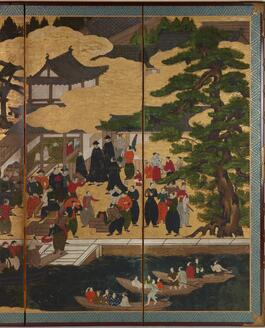
In the late 16th century, significant exchange between Europe and Japan began, leading to the creation and popularity of "Nanban byobu," or screens depicting Western people and their trading scenes in Japan. This piece illustrates a Japanese harbor welcoming Southern Barbarian ships and imagined foreign landscapes. The author is suspected to be Yanagisawa Yushi (1642-1726). (190312_Special Preservation and Repair)
16世紀半ば、ヨーロッパと本格的な交流が始まったのを機に、日本では、西洋人との貿易の様子を描いた「南蛮屏風」が成立し、流行した。本作品では、南蛮船を迎える日本の港と、想像上の外国の光景が描かれる。筆者は狩野友信(1642~1726)の可能性が指摘される。(190312_特集保存と修理)
View the original at Japan Search →Article 1 describes the Ainu as the indigenous people of the northern part of the Japanese archipelago and of Hokkaido in particular, and cites international circumstances concerning indigenous peoples as a reason for acting. It requires the government to set a basic policy, and lets municipalities draw up regional plans for approval by the Prime Minister.
The cool part. The definition in Article 2 is the part to sit with. Ainu culture means the Ainu language, and the ways of living, music, dance, crafts and other cultural products inherited among the Ainu, and cultural products developed from these. That final clause refuses to freeze the culture at a date, and treats what is made next as equally the thing being protected. The Act then reaches into trademark law, reducing or waiving registration fees for regional collective trademarks used by approved projects.
Verify at e-Gov 法令検索 →Use it Palette for a single-colour run: one ink, heavy stock, nothing else on the sheet.
Description source: museum curator text, translated — not generated