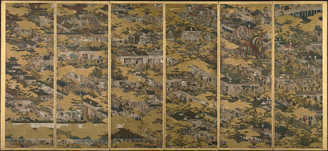
This catalog describes scenes of Kyoto's city center and outskirts. Many Rakuichu-Rakugaibu scrolls consist of panels that depict the eastern half from a western perspective and the western half from an eastern perspective, forming a pair. In contrast, this set depicts only Kyoto's central part as viewed from the south. It has been passed down in the Shokoku family of Shiga prefecture and is known as a work of the Shokoku-Rin'in school. The screen consists of six panels, with one set on each side. The central part of Kyoto as viewed from the south is depicted on the screen. A river that flows diagonally to the right bottom links the left and right scenes. This is the Kamo River, which flows from east to west through Kyoto. To the left is Sengoku Castle of the Tokugawa family, which contrasts with Kyoto's cityscape. To the right stands the Grand Hall of Daibutsu-den in Horyuji Temple, built by Toyotomi Hideyoshi. There are more than 2500 people of various ages, living and playing, depicted in the screen. For example, in the central panel of the right screen, you can see the crowd of people crossing the bridge, which is the Gojo Bridge. On the left side of the screen, there's a group of people enjoying the cherry blossoms. At the end of the screen, there's a drunk man with both arms around someone.
京都の市中と郊外を描く。多くの洛中洛外図は、街の東半分を西から見て描いたものと西半分を東から見たもので一組となっているが、ここでは京都の中心部だけを南から見て描いている。滋賀の舟木家に伝来し、舟木本の名で親しまれている。 6枚のパネルをつないだ屏風が、左右で1セットになっています。京都の中心部を南から眺めた風景を描いています。右下にむかって斜めに流れる川が、左右の画面をつないでいます。これは京都の東を南北に流れる鴨川で、ここよりも西(画面左方)が洛中(らくちゅう・京都の市街)、東(画面右方)が洛外(らくがい・郊外)です。右端の大きなたてものは豊臣秀吉が建てた方広寺大仏殿。左端には徳川氏の二条城を置き、京都のまちをはさんで対立させているようです。 老若男女、およそ2500人の人びとが遊び、暮らすさまが、生き生きと描かれています。たとえば、右側の屏風の中央やや左手にかかる大きな橋を見てみましょう。これは五条大橋。お花見の帰りなのか、浮かれ騒いでいる集団が橋を渡っています。先頭では、扇や桜の枝を持った人たちが踊りくるっています。最後尾には両脇を抱えられ、酔いつぶれた男。この大騒ぎに驚いて、橋の下からは船頭さんが見上げています。遊んでいる子どもたちがいたり、喧嘩をしている人たちがいたり、一人ひとりの顔の表情に注目してみると、屏風の世界に引き込まれてしまいます。 さらに、 三十三間堂、清水寺、八坂神社、祇園祭など、今も訪ねることのできる京都の名所や行事を探してみる楽しみ方もあります。作者の岩佐又兵衛(いわさまたべえ)は安土桃山時代から江戸初期にかけて京都、福井、江戸で活躍した画家で、生き生きとした人物描写を得意としました。
View the original at Japan Search →Article 3 tells libraries what to gather, and the list is wider than books: local materials, local administrative records, works of art, records and film. Article 3 also requires interlibrary lending, travelling collections and mobile libraries, so that the holdings move toward the reader rather than waiting.
The cool part. Article 17 is one sentence and admits nothing. A public library may not collect an admission fee, or any consideration whatsoever, for the use of library materials. Free is not a policy that a budget round can revisit, it is the statute. Article 26 is stranger still: the state and local authorities must not interfere in the work of a private library, and must not give it a subsidy. Independence is protected by withholding the money.
Verify at e-Gov 法令検索 →Use it The border is the idea. Use it as an edge treatment and leave the centre empty.
Description source: museum curator text, translated — not generated