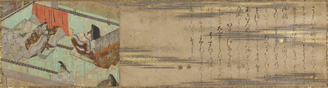
The author Murasaki Shikibu of "The Tale of Genji" depicting the management of the imperial court at Heian Palace. Currently, about twenty scrolls exist, each stored in different places. Originally, this was a scroll, but in Showa 8 (1933), Masuda Noudou separated the scrolls into individual paintings, which are now the hanging scrolls. It is a representative work of Heian period court literature. This work is a painting based on the "The Tale of Genji" by Murasaki Shikibu, which was turned into a scroll. It records in detail the events surrounding the birth and aftermath of a prince, who later became Emperor Atsuhira, as well as the ceremonies held for the prince's 50-day celebration. As a literary work, it is an invaluable resource for understanding the lifestyle of Heian period nobles. This painting depicts a scene from the 50-day celebration ceremony for Atsuhira's birth. The woman on the right, with her back turned, is the emperor's mother, Shoushi. The man on the left is Fujiwara no Michinaga, who held significant power at the imperial court at the time. His wife, the mother of Shoushi's child, is Empress Thekiko, who is also depicted in the painting. Interestingly, this painting was created during the Heian period, over 200 years after Murasaki Shikibu's time.
『源氏物語』の作者・紫式部が宮中での営みをつづった『紫式部日記』を描いた作品。現在、二十数段が現存し、各所に分蔵されている。この断簡ももとは巻子であったが、昭和8年(1933)、益(ます)田(だ)鈍(どん)翁(のう)が絵巻を分け、現在の掛幅装となった。鎌倉時代王朝物語絵の代表作である。 日本の古典文学の最高峰とも言われる「源氏物語」の筆者、紫式部(むらさきしきぶ)の日記を絵巻にしたものです。紫式部が仕えていた一条天皇の中宮彰子(しょうし)が、のちに後一条天皇となる敦成(あつひら)親王を出産した際の様子や産後のお祝いの儀式についてなど、親王誕生前後の数年間の出来事が詳細に記されています。文学作品としてはもちろん、平安時代の貴族たちの暮らしを今に伝える貴重な資料です。 これは敦成親王の誕生50日を祝う儀式の場面を切り取って、掛け軸にしたものです。画面右側、背を向けている女性が中宮彰子。画面下の男性は、彰子の父で、当時宮廷で大きな権勢を振るっていた藤原道長。そして、左は、道長の妻であり彰子の母である北の方と生後50日を迎えた親王です。 ところで、この絵巻が描かれたのは、鎌倉時代で、紫式部の時代から200年以上あとのことです。引目鉤鼻と呼ばれる人物の類型的な描き方など、平安時代の伝統的なやまと絵と同様に見えますが、よく見るとそれぞれの人物の個性や表情が表わされていることに気付きます。リアリティを求めた、鎌倉時代ならではの表現といえるでしょう。また、道長が着ているのは、鎌倉時代に流行した強装束(こわしょうぞく)と呼ばれる糊づけされた直線的な衣です。 鎌倉時代の人びとの好みを反映させた、王朝絵巻ということができるかもしれません。
View the original at Japan Search →It protects not the buildings but the setting that holds them. Article 2 defines historic landscape as land where structures and remains of historical significance form a single whole with the surrounding natural environment, which is the legal way of saying the hills, the approaches and the sightlines. The ancient capitals are Kyoto, Nara and Kamakura, plus any other municipality added by Cabinet Order. The Minister of Land, Infrastructure, Transport and Tourism designates a preservation area; city planning then carves a Special Preservation District over its core, and inside that district an owner needs permission from the prefectural governor to build, to fell timber, or to change the shape of the ground.
The cool part. It legislates the view, and then it pays for it. Article 10 requires the prefecture to compensate an owner who suffers loss because permission was refused. Article 12 goes further: where refusal seriously impairs the use of the land, the owner can require the prefecture to buy it, at market value. So the state does not merely tell you what the horizon behind a temple may look like. It agrees to purchase the land rather than let the skyline change. Two more things worth knowing. The prefecture must physically sign the district boundary, and a landowner may not obstruct the sign without just cause. And the ministry holding the pen is Transport, not Culture.
Verify at e-Gov 法令検索 →Use it The border is the idea. Use it as an edge treatment and leave the centre empty.
Description source: museum curator text, translated — not generated