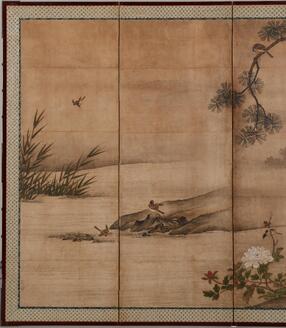
Ink paintings that depict motifs have a long tradition in Japanese watercolor art, with plants, birds, and animals often serving as subjects. The illustration introduced here is one such example. This work consists of two screens, sold as a set, that represent a tranquil garden where nature and birds harmonize. The left and right screens are designed so that the central point of gravity is achieved by depicting rocks and trees at their edges. The motif themes of flowers and birds are vibrantly colored, contrasting with the monochrome background, creating an elegant and beautiful effect. The birds come in various types, but upon closer observation, they appear interconnected. Lone birds can be found as well, leading the viewer's gaze to discover another bird nearby. The trees and flowers are meticulously arranged, as if following the birds' movements, creating a scene that resembles a natural setting. However, upon closer inspection, each motif has been calculated and drawn with intricate precision. The artist is said to be one of the greatest masters of Japanese painting, a member of the Rinpa school, Yuki no Hide (Yuki no Bu). He was the younger brother of the founder of the Rinpa school, Rinpa School's second generation, Yuki no Tō (Yuki no Tō).
墨の濃淡でモチーフを描く水墨画では、植物や鳥・動物が題材としてよく用いられます。今回ご紹介する花鳥図もその一つです。この作品は2つの屏風を1セットとして、自然と鳥が織りなす楽園を、墨のトーンに色を加えて表現しています。 左右の屏風を並べて置いたときに、その両端に重心が来るように岩や木々を描いています。主題となる花や鳥には鮮やかに色を塗り、墨だけで描いた背景との対比によって華やかさを演出しています。鳥は数種類が描かれていますが、よく見るとそれぞれがつがいになっています。単独の鳥もいますが、視線の先を追っていくとペアになるように他の鳥が見つかります。樹木や花は、その鳥の動きに沿うように絶妙に配置されています。自然の情景を描写したように見えますが、実はそれぞれのモチーフを緻密に計算して描いているのです。 作者は日本絵画史上最大の絵師の集団、狩野派の一人、狩野之信(ゆきのぶ)かと言われています。之信は狩野派の基礎を築いた二代・狩野元信の弟で、室町時代後期に活躍しました。兄・元信の、水墨画に彩色を加えるというスタイルをふまえ、さらにそれぞれのモチーフをいかに美しく見せるかということを極めていった、之信の特徴がうかがえる作品です。 精緻な筆使いと緊密な図様構成による、様式美の極致を示す華麗な花鳥図です。孔雀や金鶏、牡丹や紅椿など、吉祥の花と鳥とが色彩豊かに描かれ、水墨による背景がそれをいっそう引き立てています。作者の輞隠は、狩野派の二代目・元信の弟にあたる之信とする説が有力です。 @せいち@きんみつ@きょくち@くじゃく@きんけい@ぼたん@べにつばき@きっしょう@すいぼく@もういん@かのうは@もとのぶ@ゆきのぶ
View the original at Japan Search →Japan implementing the 1970 UNESCO Convention. When a foreign state reports that cultural property has been stolen from an institution, the Ministry of Foreign Affairs notifies the education ministry, which designates the object as specified foreign cultural property, after consulting the trade ministry. Importing a designated object then requires approval under the foreign exchange and trade law.
The cool part. Article 6 quietly rewrites private law. Under the Civil Code a good-faith purchaser is normally secure against a recovery claim after two years. For designated stolen foreign cultural property, the victim may demand recovery from two years after the theft until ten years have passed. Buying in good faith does not settle the question for a decade, which is roughly how long it takes a stolen object to surface on a legitimate market.
Verify at e-Gov 法令検索 →Use it The border is the idea. Use it as an edge treatment and leave the centre empty.
Description source: museum curator text, translated — not generated