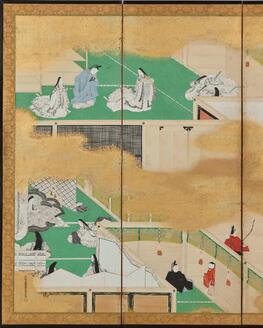
A screen painting with a historical story about Heian period's Fujiwara Michinaga as the theme. On the right, a scene from the episode "Moon Viewing Party at Emperor Murakami's Court" (Roll One: "Tsuki no En") is depicted. On the left, a scene from the episode "The Birth of Chūgoku Shōshi in the Middle Palace" (Roll Eight: "Hatsuhana") is portrayed. The screen painting, titled "The Story of Splendor," depicts historical episodes from the Heian period. Roll One (Maki no Ichi) features the scene from "Moon Viewing Party at Emperor Murakami's Court," and Roll Eight (Maki no Hachi) presents the scene from "The Birth of Chūgoku Shōshi in the Middle Palace." On the right-hand screen, a scene is depicted under the light of the fifteenth night's moon, with Emperor Murakami's court adorned with elegant decorations. You might see a wooden stand with a sculpted pine tree and a painted one nearby. Both the pine tree and the painting have a curved shape, representing the "Shūhama" (Entrance Bay) form of a sandy beach. The Shūhama, symbolizing a pure and auspicious place for gods and buddhas to descend, is portrayed in both three-dimensional and flat forms, highlighting their beauty. A distinguished observer can be found behind the folding screen. On the left side of the screen, the interior arrangement and costumes are uniformly white. This is the scene of Chūgoku Shōshi's birth.
平安時代の藤原道長の栄華を主題にした歴史物語を絵にした屏風である。右には村上天皇の御前で、左右に分かれて植木の優劣を競う前栽合せ(巻一「月の宴」)を、左には中宮彰子が皇子を出産する場面(巻八「初花」)を描く。 藤原道長:ふじわらのみちなが 前栽合:せんざいあわ 中宮彰子:しょうし(190423_h07更新) 藤原道長の権力と栄華をテーマにした平安時代の歴史物語「栄花物語」を絵にした屏風です。右の屏風には巻一(まきのいち)の「月の宴(つきのえん)」、左には巻八(まきのはち)の「初花(はつはな)」というエピソードからの場面が描かれます。 右側の屏風では、十五夜の月の光の下、村上天皇(むらかみてんのう)の御前で飾り物の出来栄えを競う様子があらわされています。右上のあたりに、木彫りの松の置かれた台と、絵の置かれた台が見えるでしょうか。松の木のある台も、絵も、雲のような曲線的な形をしています。これは「州浜(すはま)」といい、入り組んだ砂浜の形を上から見たものです。神仏の降り立つ清らかな場所として、おめでたい意味を持つ州浜を、それぞれ立体と平面で表現してその優劣を競っています。判断する高貴な人物は、御簾の向こうにいらっしゃるようです。 左の屏風の左側の場面では、室内の調度も女性たちの装束も白で統一されています。これは中宮彰子(ちゅうぐうしょうし)の出産の場面です。平安時代、出産時の空間は白を基調に統一されていました。小さな赤ちゃんを抱いている人物、見つけられるでしょうか。 描かれているのはどちらも秋の出来事。薄(すすき)や女郎花(おみなえし)、菊などの秋草が季節をあらわしています。
View the original at Japan Search →Article 2 defines a museum as an institution that collects, keeps and displays materials on history, art, folklore, industry and natural science for public use, carries out research on them, and which has been registered under Chapter 2 of this Act. The registration is not decorative. In law, an unregistered collection open to the public is not a museum.
The cool part. The definition of keeping is given as including raising. That single parenthesis is why a zoo, an aquarium and a botanical garden sit inside museum law in Japan: the collection is allowed to be alive. Article 1 also grounds the statute in the Social Education Act and the Basic Act on Culture and the Arts, which places museums in education first and culture second.
Verify at e-Gov 法令検索 →Use it Palette for a single-colour run: one ink, heavy stock, nothing else on the sheet.
Description source: museum curator text, translated — not generated