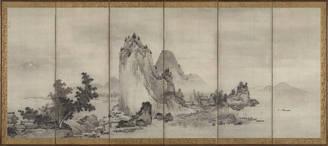
This painting, titled "Equally," was created during the Edo period and showcases the Snowy Boat style, which originated in China and had a significant influence on the painting scene in northern Kyushu. The image features motifs of snowy landscapes, such as mountains, rocks, and boats, found in random places. The characteristic features of this painting are its stable composition and the peaceful, tranquil scenes. This is a folding screen painting with winter scenes on one side and summer scenes on the other. The artist, Unkoku Togan (Ungoku Togan), was a watercolor painter active during the Muromachi period who aimed to carry on the Snowy Boat (Sesshu) style. The influence of Snowy Boat is evident in the strong brushstrokes on mountains and rocks, as well as the choice of motifs, such as mountains, boats, and people. However, Togan also developed his unique expression. In this landscape painting, the large motifs in the foreground are pushed to the edges of the screen, while the central space is left open to emphasize depth. Despite the simplified forms of mountains and trees, the boats, people, and textures of the rocks are meticulously detailed. The fine details contribute to the overall weighty feeling of the painting. Upon closer inspection, it becomes apparent that the ink is not the only color used. Soft blue or red tones are also employed.
等顔は、毛利輝元(もうりてるもと)に仕え、雪舟流を標榜した。江戸期を通じて、その画系は中国地方から北九州の画壇に大きな影響力をもった。本図は岩山や人家、泊り舟など随所に雪舟風のモチーフが見出されるが、整然とした画面構成と、温和で静謐な情景は等顔の特色である。(2006/05/23) これは、右側に冬、左側に夏の景色を描いた屏風です。作者の雲谷等顔(うんこくとうがん)は、室町時代に活躍した水墨画家、雪舟(せっしゅう)の画風を引き継ごうとしていました。山や岩にみられる強い筆のタッチや、岩山や人家、舟などのモチーフの選び方にも雪舟の影響が見られますが、等顔はさらに彼独自の表現を作り上げていきました。こうした山水画では、近景にある大きなモチーフを左右の端に寄せて描き、真ん中の空間をあけて遠近を強調するものが多いのですが、ここでは切り立った山を、それぞれの屏風の端に寄せず中央寄りに描くという大胆な構図をとっています。しかし、山の後ろにまで回りこむ道や、遠ざかるにつれ淡く描かれる木々、空に小さく浮かぶ月などにより、十分にひろびろとした空間とその奥行きが表現されています。岩山や木々の形は単純化されていますが、舟や人家、岩の質感や量感、一枚いちまいの木の葉など、細部を丁寧に描きこんでおり、ずっしりとした重量感が生まれています。よく見ると、墨だけでなく、淡いブルー、あるいは赤みをおびた色が用いられています。水や人びとがゆらりと動き出しそうな気配や温かみを感じさせてくれます。
View the original at Japan Search →Article 2 defines a museum as an institution that collects, keeps and displays materials on history, art, folklore, industry and natural science for public use, carries out research on them, and which has been registered under Chapter 2 of this Act. The registration is not decorative. In law, an unregistered collection open to the public is not a museum.
The cool part. The definition of keeping is given as including raising. That single parenthesis is why a zoo, an aquarium and a botanical garden sit inside museum law in Japan: the collection is allowed to be alive. Article 1 also grounds the statute in the Social Education Act and the Basic Act on Culture and the Arts, which places museums in education first and culture second.
Verify at e-Gov 法令検索 →Use it Two-colour foil on uncoated stock gets you most of this at production cost.
Description source: museum curator text, translated — not generated