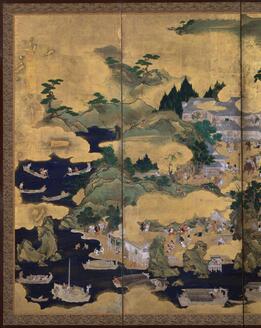
This painting depicts the view of Itsukushima Shrine from the north, with continuous scenes of people enjoying recreation. The floating torii gate of Itsukushima Shrine and other common motifs in early modern pleasure painting are also used. As a valuable work for considering the transmission of the painting style, it is currently a screen painting of Itsukushima Shrime as seen from the north. The scene shows lively people, including pilgrims exploring the island in boats and those welcoming them to lodgings. The red sacred hall area is the domain of the deities. Deer, which guide people to each scene in the gods' realm, are drawn here. The deep relationship between people and deer is also visible from the fence. Pleasure paintings that depict such leisurely scenes became popular in the late Edo period. Despite depicting sacred places, the main subjects are people. This is because Itsukushima and other places, which are both beautiful landscapes and sacred sites, were visited and enjoyed by people, thanks to the hospitality of Itsukushima. This screen painting depicts an ideal place filled with joy and pleasure where people can enjoy themselves while paying respects.
厳島神社を中心に、厳島を北側からみた景色を連続した一双の画面に描いたもので、多くの人物の遊楽の様子がみてとれる。舟木家本「洛中洛外図屏風」(当館所蔵)など近世初期風俗画と共通する図柄も用いられており、図様継承を考える上でも貴重な作品である。 現在の広島県にある厳島神社を描いた屏風です。厳島を北側から見た景色を、遊楽に来る人びとの活気とともにあらわしています。島に舟で辿りつく参拝者、彼らを宿坊に迎え入れもてなす人びとなどが生き生きと描かれ、その賑わいが聞こえてきそうです。 人びとの生活空間に対し、赤い社殿のあるエリアは神仏の領域です。こちらにはそれぞれのシーンに神域で人を導くガイドのように鹿が描かれており、人と鹿との深い関係も垣間見えます。 このように、描かれた風俗を見て楽しむ絵画は、江戸時代に入るころに流行し、数多く制作されました。なかでも、人びとがイメージしやすい神仏に関わるシンボル的なモチーフがあり、景色も美しい名所として、厳島や松島などは多く描かれました。聖なる場所を旅するイメージで、こうした絵は鑑賞されていたのでしょうか。 聖なる場所を描きながらも、主役は人。こうして生き生きと人びとがあるのも厳島のご加護のおかげ、というわけで、人びとが楽しみながら参詣している、喜びに満ちた理想郷を描いた屏風です。
View the original at Japan Search →A statute built to coax privately held work onto public walls. An owner registers a piece with the Commissioner for Cultural Affairs, then contracts with a museum to display it. Article 2 defines a work of art broadly, as paintings, sculpture, crafts and other tangible cultural products that are movable, which is the legal way of saying anything you could carry out of the house.
The cool part. The terms are the interesting part. Article 2 requires the public display contract to run for five years or more, and to contain a clause stating that the parties may not give notice of cancellation. You cannot lend a masterpiece for the tax treatment and then reclaim it when the market turns. Japan concluded the barrier to seeing art was never storage. It was ownership, and the fix was a contract you cannot walk out of.
Verify at e-Gov 法令検索 →Use it Two-colour foil on uncoated stock gets you most of this at production cost.
Description source: museum curator text, translated — not generated