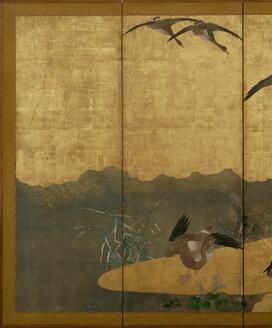
In the background of the gold leaf, a contrast is presented between the seasons changing from summer to autumn, with flocks of birds flying in by the water and others resting with their wings spread out. The calculated composition and the intentional formation of the birds can be seen on the screen even during the early Edo period.
金箔地の背景に夏から秋へと移ろう季節のなかで、水辺に飛来する雁と羽を休める一群が「動」と「静」の強いコントラストであらわされている。計算された構図、意匠化された雁の形態など、江戸時代前半にもてはやされた表現が画面に描き出されている。
View the original at Japan Search →Article 1 sets a purpose larger than preservation: to preserve cultural properties AND to make use of them, contributing to the cultural advancement of the people and to the progress of world culture. Article 4 turns that outward. An owner must recognise the object as a precious national asset, preserve it for the public, and make it public as far as possible. Ownership here carries a duty to show.
The cool part. "Living National Treasure" appears nowhere in the statute. Article 71 requires that when an Important Intangible Cultural Property is designated, the minister must also certify its holder or holding group. Japan does not register the pot, it registers the potter. Article 96 is the one that reaches ordinary people: if you uncover a shell mound, a dwelling site or a tumulus, you must leave it exactly as it is and notify the Commissioner for Cultural Affairs without delay, and the Commissioner can freeze the ground for up to three months.
Verify at e-Gov 法令検索 →Use it Take the ratio, not the picture. It sets a page better than a grid does.
Description source: museum curator text, translated — not generated