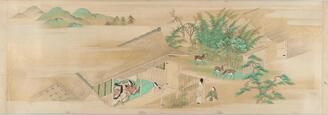
This is a work representing the six-volume illustrated version of the "Tale of Isshi," featuring Isshi Yasunobu as the leading character. It is a significant work transitioning from the Tosa School to the Yoshida School, with the calligrapher being particularly notable. It was passed down as a valuable heirloom from the Shogun's inner palace of the Tokugawa shogunate to the Tsutenkaku family. (Ariwara Narihira's Kobayagi Yūimotsu) (Created: Akasaka Hikaru, 2009-02-26) (2007/06/05_h082)
これは在原業平を主人公とする『伊勢物語』を6巻の絵巻に表わした作品である。土佐派から出て住吉派をおこした如慶の代表作で、詞書の筆者が明らかなことも貴重である。四代将軍徳川家綱の正室高厳院の御遺物として津軽家に伝来した。(ありわらのなりひら ことばがき ごゆいもつ) (作成: 赤羽光2009-02-26)(2007/06/05_h082)
View the original at Japan Search →A national statute written for one city. Article 1 recites the beauty of Kyoto and its historically, culturally and artistically important position in the world, and gives two purposes: to raise international culture and serve the ideal of permanent world peace, and to contribute to the economic recovery of Japan. It was passed five years after the war ended.
The cool part. Article 3 lets Kyoto designate culture tourism preservation districts and, by ordinance, prohibit building, rebuilding, removal, changes to the shape of the land and the cutting of bamboo, trees and stone, with compensation for ordinary loss. Then Article 4 does something statutes almost never do. It places a duty on the mayor personally: in the spirit of local autonomy, and with the cooperation of residents, the mayor must engage in ceaseless activity to complete the city. Nara received its own Act, number 250, the day before.
Verify at e-Gov 法令検索 →Use it Take the ratio, not the picture. It sets a page better than a grid does.
Description source: museum curator text, translated — not generated