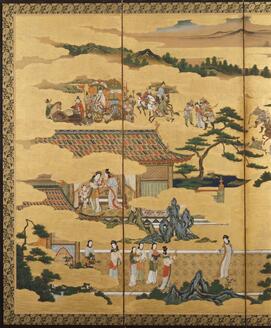
The white heron's tale "Changhenga" by Akasagotami (Hakurakuten) is a story of tragic love between Genjō (Genkō) and the Yang Guifei (Yōkihi). The scene is depicted in a multi-screen style with Genjō and the Yang Guifei positioned at the lower middle and upper right. The lower part represents the happy period of their lives, while the upper part depicts the unrest at Anlo Mountain and Genjō's escape during the tragic period, which is found in the first half of the story. This work is a masterpiece of the early 17th century Kano School.
白楽天(はくらくてん)の叙事詩『長恨歌』は、玄宗(げんそう)・楊貴妃(ようきひ)の悲恋物語。その名場面をマルチ画面風に描いています。下中央と上右端に玄宗・貴妃。下部は幸福な時期、上部は安禄山(あんろくざん)の乱・玄宗の逃亡と悲劇の時期で、物語前半部にあたります。各種描法からみて17世紀初の狩野派の力作です。
View the original at Japan Search →Article 1 gives three grounds for regulating a sign: forming good landscape, maintaining scenic character, and preventing danger to the public. Article 3 then lets a prefecture prohibit outdoor advertising outright, by ordinance, in named categories of place.
The cool part. Read the list in Article 3 and it stops being an advertising law. The places where signage can be banned include landscape districts, scenic districts, preservation districts for groups of traditional buildings, the surroundings of designated Important Cultural Properties, and historic sites, places of scenic beauty and natural monuments. The statute protects the view by removing the sentences written across it.
Verify at e-Gov 法令検索 →Use it Take the ratio, not the picture. It sets a page better than a grid does.
Description source: museum curator text, translated — not generated