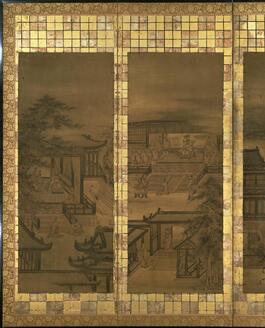
Collection of stories about Chinese emperors acting as role models or opposite teachers. On the right side, there are six images of good deeds, and on the left side, there are six images of foolish actions. The traditional Chinese painting technique of "kamigata" is used to clarify the structure of the buildings through regulated line drawing, and to depict the figures as the main subjects using line drawing. This important work served as the starting point for the research of Yanagida Kunio. (161101_h082)
為政者が手本あるいは反面教師とすべき中国の諸帝王の故事集。右隻は善行6図、左隻は愚行6図。伝統的な中国絵画の「界画」の手法により、定規を用いた線描で楼閣の構造を明解に描き、人物を線描主体で活写している。山楽研究の出発点となった重要作品だ。(161101_h082)
View the original at Japan Search →Japan implementing the 1970 UNESCO Convention. When a foreign state reports that cultural property has been stolen from an institution, the Ministry of Foreign Affairs notifies the education ministry, which designates the object as specified foreign cultural property, after consulting the trade ministry. Importing a designated object then requires approval under the foreign exchange and trade law.
The cool part. Article 6 quietly rewrites private law. Under the Civil Code a good-faith purchaser is normally secure against a recovery claim after two years. For designated stolen foreign cultural property, the victim may demand recovery from two years after the theft until ten years have passed. Buying in good faith does not settle the question for a decade, which is roughly how long it takes a stolen object to surface on a legitimate market.
Verify at e-Gov 法令検索 →Use it A motif small enough to blind-deboss, which is where restraint actually shows.
Description source: museum curator text, translated — not generated