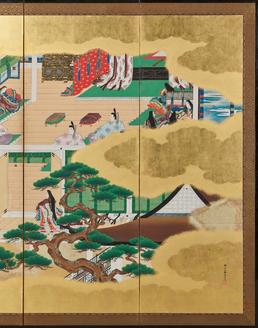
From the famous scenes of "The Tale of Genji": On the right, women are critiquing a painting in front of the Emperor Go-Daigo. On the left, Aochiko Palace is conducting a Buddhist ritual called "Kochou." Vibrant colors, the brilliant white of cherry blossoms creating a lively scene. The artwork was created from around Filial Piety 2nd year to Tenpo 5th year (1819-1834). (Written by Kanou Seisenin) Two byōbu (screens) are set up. Each depicts a scene from "The Tale of Genji" in vivid gold, green, red, and other deep colors. The screen on the right is the scene of "Eawase (the Critique of Pictures)": Women are seen facing each other, presenting their paintings and determining the winner. Two wide spaces are left in front of them, likely for the hanging of the paintings. On the left screen, there is a mysterious figure in dance attire. This is the scene of "Kochou." Four children dressed as butterflies are conducting a Buddhist ritual with the branches of a mountain cherry tree. Though unrelated in the story, the white blooming cherry blossoms connect the two screens in this artwork. The bright and lively scene is reminiscent of spring. Kanou Seisenin, the author of this artwork, was an important figure in the Kanou school during the late Edo period. He held various positions, including the overall supervision of the Edo Castle byōbu paintings.
『源氏物語』の名場面から。右隻は女御たちが冷泉帝の御前で絵を批評しあう「絵合」、左隻は秋好中宮が春の仏事を行なう「胡蝶」。鮮やかな色彩、桜花の輝く白が華やかな画面を生んでいる。作者が法眼位にあった文政2年から天保5年(1819~1834)の作。 (山下善也氏執筆) ふたつの屏風がセットになっています。それぞれ、『源氏物語』の一場面を金地に緑や青、赤などの濃い色彩で鮮やかに描いています。 向かって右側の屏風は、「絵合(えあわせ)」の帖の場面です。左右にわかれ、一組ずつ絵を提出し、勝負を判定する「絵合」という遊びの様子が描かれています。広い空間に向かい合わせに置かれている二つの箱の中に、絵が入っているのでしょう。左側の屏風には、不思議な扮装をした踊り手がいます。これは「胡蝶(こちょう)」の帖の一場面。春の仏事に、蝶の羽をつけた4人の子どもが山吹の枝を手に舞っています。物語の上では2つの場面に関連はありませんが、この作品では白く輝く桜の花が左右の屏風をつないでいます。明るく華やかな画面が春らしい作品です。 作者の狩野晴川院(かのう せいせんいん)は、江戸城の障壁画の総指揮監督を務めるなど、幕末期の狩野派の重要人物でした。
View the original at Japan Search →Article 1 states the purpose plainly: prevent trade in stolen goods, find them quickly, and speed the recovery of victims. Article 2 then defines a used article to include, in the same breath, art objects held for appreciation. Dealing in them requires a licence.
The cool part. Article 16 requires a dealer to record every transaction: the date, the item and quantity, its distinguishing features, and the address, name, occupation and age of the other party. Article 15 requires that a dealer who suspects an item is stolen report it to a police officer immediately. So the antique trade runs on a register the police may read, and a painting becomes a second-hand article the moment it has been used once.
Verify at e-Gov 法令検索 →Use it Two-colour foil on uncoated stock gets you most of this at production cost.
Description source: museum curator text, translated — not generated