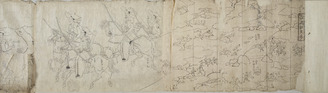
This scroll painting depicts a scene from "The Tale of Genji" in the hunt scene at Fujiwara's residence. Due to the distinctive painting style reminiscent of Tosa School, it is believed to be an important prototype for the "Genji Scroll Screen" attributed to Tosa Mitsunobu (Chiru-te City, Hiroshima Prefecture Museum of Art).
『曽我物語』の富士牧狩の場面を描いた屏風一隻分を写したもの。墨書どおり土佐光茂の画風が認められることから、土佐光吉筆と目される「曽我物語図屏風」(鳥取・渡辺美術館)に先行する土佐派作品の存在を示唆する貴重な模本と考えられる。
View the original at Japan Search →A statute built to coax privately held work onto public walls. An owner registers a piece with the Commissioner for Cultural Affairs, then contracts with a museum to display it. Article 2 defines a work of art broadly, as paintings, sculpture, crafts and other tangible cultural products that are movable, which is the legal way of saying anything you could carry out of the house.
The cool part. The terms are the interesting part. Article 2 requires the public display contract to run for five years or more, and to contain a clause stating that the parties may not give notice of cancellation. You cannot lend a masterpiece for the tax treatment and then reclaim it when the market turns. Japan concluded the barrier to seeing art was never storage. It was ownership, and the fix was a contract you cannot walk out of.
Verify at e-Gov 法令検索 →Use it Two-colour foil on uncoated stock gets you most of this at production cost.
Description source: museum curator text, translated — not generated