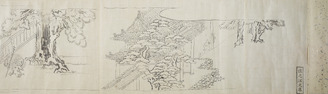
This is a well-known scroll painting from the Muromachi period called "Hyakki Yakou Emaki," which has a different image from the commonly known one, according to the title. It is said that this was painted by the person named Hōshi Hiroshige based on the original drawn by Tosa Mitsunobu. A nearly identical painting exists in the collection of Fukuoka Jinja-in, which is said to be a copy of Hōshi Reppō's copy.
よく知られた室町時代の「百鬼夜行絵巻」とは異なる図様をもち、外題によれば土佐光起による原本を住吉広尚が写したものという。これとほぼ同じ図様を写した狩野晴川院養信による模本(当館蔵)が存在し、こちらは住吉如慶の模写本をさらに写したものと伝える。
View the original at Japan Search →Article 2 defines a museum as an institution that collects, keeps and displays materials on history, art, folklore, industry and natural science for public use, carries out research on them, and which has been registered under Chapter 2 of this Act. The registration is not decorative. In law, an unregistered collection open to the public is not a museum.
The cool part. The definition of keeping is given as including raising. That single parenthesis is why a zoo, an aquarium and a botanical garden sit inside museum law in Japan: the collection is allowed to be alive. Article 1 also grounds the statute in the Social Education Act and the Basic Act on Culture and the Arts, which places museums in education first and culture second.
Verify at e-Gov 法令検索 →Use it Palette for a single-colour run: one ink, heavy stock, nothing else on the sheet.
Description source: museum curator text, translated — not generated