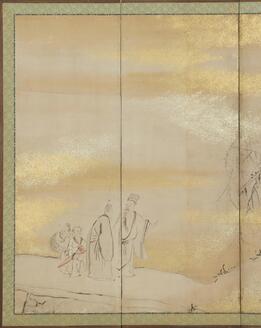
A flying crane, a fully bloomed plum tree, and a house. A poet from the Northern Song Dynasty named Lin Hejing (Lin Xu) is returning to his study, and a boy is waiting for him at the gate. This is a screen painted with eight scenes from a folding screen. It was created during the golden age of literary painting in the Edo period with a brush by the scholar Okamoto Taiso. Based on the painting style, it is estimated to have been created around the 30-year-old period.
飛ぶ鶴、満開の梅林と人家。梅を愛し鶴と暮らしたという北宋の詩人、林和靖(林逋)が自亭に帰る場面で、玄関で童子が待ち受けています。襖絵8面分を屏風に改装したものです。江戸時代の文人画の黄金期を確立した池大雅の筆で、制作時期は画風から30歳代と推定されます。
View the original at Japan Search →A weapons statute that contains the most important art registry in the country. Article 2 defines a sword by measurement: a blade of fifteen centimetres or more for a sword, spear or naginata, five and a half for a dagger. Article 14 then carves out an exception. The prefectural board of education registers old firearms of value as art or antiques, and swords of value as art, on the basis of an appraisal by registration examiners appointed for their scholarly knowledge.
The cool part. A Japanese sword is lawful to own because it has been certified as art. Not because it was disarmed, not because it was licensed as a weapon. The judgement is made by the board of education, and Article 14 then requires the board to notify the prefectural public safety commission of what it has decided. The culture side rules, and the police are informed afterwards. Fail the appraisal and the same object becomes contraband.
Verify at e-Gov 法令検索 →Use it A motif small enough to blind-deboss, which is where restraint actually shows.
Description source: museum curator text, translated — not generated