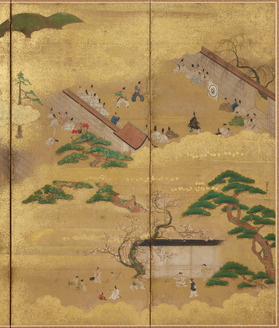
Against the backdrop of Kyoto's Eastern Mountains, children's play during the beginning of the New Year with bows and arrows under the plum trees, and the heron dance at the Gion Festival, among other events from New Year to summer, are depicted. A "Moon Calendar Fan-painting Screen" from the 15th century or earlier was seized, and parts of it show the appearance before the Onin Disturbance. The author, Yanagida Yasuke, was a disciple of Yanagida Soko, the head of the Yanagida family residing at Shibatadaira Yanagida House.
京都東山を背景に、正月の弓初め、梅の下での子供の遊び、祇園祭での鷺舞や山鉾行列など正月から夏の行事が描かれている。15世紀以前制作の「月次風俗図屏風」を踏襲して、応仁の乱以前の様相を示す部分が散在する。筆者狩野益信は、狩野探幽の養子で駿河台狩野家の祖。
View the original at Japan Search →A national statute written for one city. Article 1 recites the beauty of Kyoto and its historically, culturally and artistically important position in the world, and gives two purposes: to raise international culture and serve the ideal of permanent world peace, and to contribute to the economic recovery of Japan. It was passed five years after the war ended.
The cool part. Article 3 lets Kyoto designate culture tourism preservation districts and, by ordinance, prohibit building, rebuilding, removal, changes to the shape of the land and the cutting of bamboo, trees and stone, with compensation for ordinary loss. Then Article 4 does something statutes almost never do. It places a duty on the mayor personally: in the spirit of local autonomy, and with the cooperation of residents, the mayor must engage in ceaseless activity to complete the city. Nara received its own Act, number 250, the day before.
Verify at e-Gov 法令検索 →Use it A motif small enough to blind-deboss, which is where restraint actually shows.
Description source: museum curator text, translated — not generated