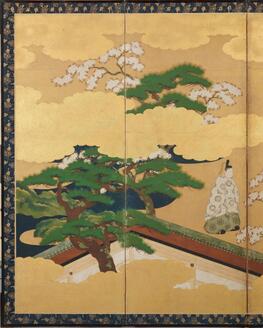
This screen painting depicts the story of "Wakamatsu" from the "Genji Monogatari" (The Tale of Genji) in the third volume. The setting is the garden of the Six Barriers Palace of the Genji clan, where cherry blossoms bloom. A cat suddenly jumps up and rolls up the screen, revealing Lady Three Shrines, the wife of Genji, who stands there. The scene of Kashiwagi, who falls in love with her, is dramatic. This work is attributed to the Yamanote painter Tosa Mitsuoki from the early Edo period. Other women present are Kashiwagi, Kari, Karneko, Misu, and Onna-san.
『源氏物語』第34帖「若菜上」を描く屏風です。舞台は桜の咲く光源氏の六条院の庭。柏木らが蹴鞠に興じる中、飛び出した唐猫が御簾を巻き上げます。そこに立つ源氏の正妻・女三宮を見た柏木が恋に落ちるという劇的な場面。江戸時代前期のやまと絵師土佐光則筆と伝わります。 ろくじょういん、かしわぎ、けまり、からねこ、みす、おんなさんのみや
View the original at Japan Search →Japan implementing the 1970 UNESCO Convention. When a foreign state reports that cultural property has been stolen from an institution, the Ministry of Foreign Affairs notifies the education ministry, which designates the object as specified foreign cultural property, after consulting the trade ministry. Importing a designated object then requires approval under the foreign exchange and trade law.
The cool part. Article 6 quietly rewrites private law. Under the Civil Code a good-faith purchaser is normally secure against a recovery claim after two years. For designated stolen foreign cultural property, the victim may demand recovery from two years after the theft until ten years have passed. Buying in good faith does not settle the question for a decade, which is roughly how long it takes a stolen object to surface on a legitimate market.
Verify at e-Gov 法令検索 →Use it A motif small enough to blind-deboss, which is where restraint actually shows.
Description source: museum curator text, translated — not generated