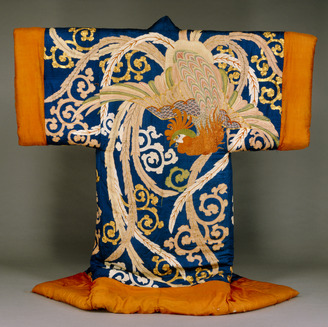
Yofuku refers to bedding in the Edo period. The phoenix pattern yofuku by Yufuku Toshimitsu can be seen in the illustrations "Shokunishinaka-ta" (published in 1686) and "Genjishinaka-ta" (published in 1687). The structure of these illustrations is similar, and the phoenix pattern yofuku is a typical auspicious design for bedding.
夜着とは、江戸時代の布団のことである。友禅染による鳳凰模様の夜着は、小袖模様雛形『諸国御ひいなかた』 (貞享3(1686)年刊)、『源氏ひなかた』(貞享4(1687)年刊)に同様の構図が見られ、典型的な夜着の吉祥模様である。
View the original at Japan Search →Article 1 gives three grounds for regulating a sign: forming good landscape, maintaining scenic character, and preventing danger to the public. Article 3 then lets a prefecture prohibit outdoor advertising outright, by ordinance, in named categories of place.
The cool part. Read the list in Article 3 and it stops being an advertising law. The places where signage can be banned include landscape districts, scenic districts, preservation districts for groups of traditional buildings, the surroundings of designated Important Cultural Properties, and historic sites, places of scenic beauty and natural monuments. The statute protects the view by removing the sentences written across it.
Verify at e-Gov 法令検索 →Use it A motif small enough to blind-deboss, which is where restraint actually shows.
Description source: museum curator text, translated — not generated