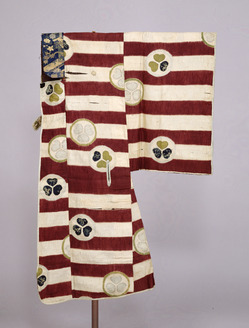
A single surviving panel of a fabric, dyed with a purple band and three-leaf clover design, is tightly bound and wrapped in a white lacquer box. According to the attached label, it was used by the Kishima family in the Takeda clan during their service in the Takeda domain. It is said to have been received as a tribute from Tokugawa Ieyasu. This fabric piece is a typical example of the binding dyeing technique passed down among the warriors during the Anlu Temple Mountain period.
白練緯地に縫い締め絞りで紫の段と三つ葉葵紋を染めた陣羽織の、片身のみが現存します。付属する帖紙によれば、高田藩に仕えた前島家の所用で、徳川家康より拝領と伝えられてきました。安土桃山時代の武将に伝来する絞り染による加工の例としては類型的なものの1つです。
View the original at Japan Search →Article 1 sets a purpose larger than preservation: to preserve cultural properties AND to make use of them, contributing to the cultural advancement of the people and to the progress of world culture. Article 4 turns that outward. An owner must recognise the object as a precious national asset, preserve it for the public, and make it public as far as possible. Ownership here carries a duty to show.
The cool part. "Living National Treasure" appears nowhere in the statute. Article 71 requires that when an Important Intangible Cultural Property is designated, the minister must also certify its holder or holding group. Japan does not register the pot, it registers the potter. Article 96 is the one that reaches ordinary people: if you uncover a shell mound, a dwelling site or a tumulus, you must leave it exactly as it is and notify the Commissioner for Cultural Affairs without delay, and the Commissioner can freeze the ground for up to three months.
Verify at e-Gov 法令検索 →Use it Two-colour foil on uncoated stock gets you most of this at production cost.
Description source: museum curator text, translated — not generated