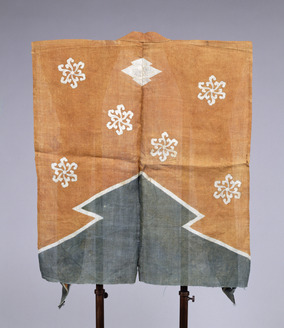
A tree bark was stylized into a shape called "matsuba-gata," which is dyed differently on the upper and lower parts. The shoulder piece has a crest in the center of the back, which is a modified snow wheel (yuki-wa) design. The snow wheel crest has two nasana-mon (nazuna-mon) patterns slightly distorted. A rare example is found in the center of the white-dyed matsuba-gata pattern, where two snow wheel patterns with nasana-mon are depicted. 20090722_h09
松の樹皮を文様化したといわれる松皮形に上下を染め分け、捻(ねじ)り花を白く染め残した肩衣。背中央に付く狂言紋は、決まり模様である雪(ゆき)輪(わ)に薺模(なずな)様をやや変形させている。白く染め抜いた松皮菱の中に、雪輪に薺紋を2つ描(かき)絵(え)で表した珍しい例である。20090722_h09
View the original at Japan Search →Unusually for a Japanese statute it opens with a preamble, which states that finding joy in creating culture and living among it is an unchanging wish of people, and that culture contributes to world peace. Article 2 then sets the principles: the autonomy of those who make culture must be fully respected, and their creativity, standing and capacity considered.
The cool part. Article 2, paragraph 3 is the line worth reading twice. It says that creating and receiving culture is a right people are born with, and requires an environment in which citizens can appreciate, participate and create regardless of age, disability, economic situation, or the area they live in. Four barriers named in statute, one of which is your postcode. It puts the arts in the same grammatical register as infrastructure. Not a subsidy argued for each year, a standing obligation.
Verify at e-Gov 法令検索 →Use it Two-colour foil on uncoated stock gets you most of this at production cost.
Description source: museum curator text, translated — not generated