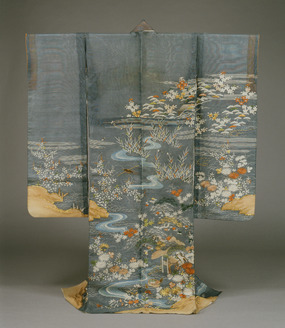
This is a summer kimono for Edo period women. Vibrant water wave pattern is used, which was imported during the Edo period and applied to silk painting and dyeing techniques. The pattern on the hat resembles the hat of the character "Yawata no Okina" (weak lawmaster), and the pattern on the water edge resembles the character "Fu" (frying pan). These are protective guardian patterns.
江戸時代後期における武家女性用の夏の単衣です。鮮やかな流水模様には江戸時代後期に輸入され錦絵や染織に利用されたプルシアン・ブルー、いわゆる「ベロ藍」が用いられています。笠に杖の模様は能「弱法師」、水辺に砧の模様は能「砧」を象徴する留守模様となっています。
View the original at Japan Search →Article 3 tells libraries what to gather, and the list is wider than books: local materials, local administrative records, works of art, records and film. Article 3 also requires interlibrary lending, travelling collections and mobile libraries, so that the holdings move toward the reader rather than waiting.
The cool part. Article 17 is one sentence and admits nothing. A public library may not collect an admission fee, or any consideration whatsoever, for the use of library materials. Free is not a policy that a budget round can revisit, it is the statute. Article 26 is stranger still: the state and local authorities must not interfere in the work of a private library, and must not give it a subsidy. Independence is protected by withholding the money.
Verify at e-Gov 法令検索 →Use it Two-colour foil on uncoated stock gets you most of this at production cost.
Description source: museum curator text, translated — not generated