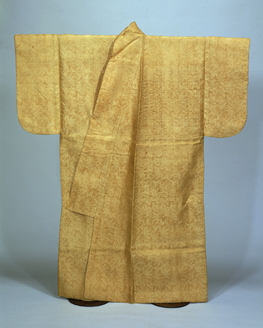
In the Muromachi period, Masudamune Yasuda of the Iwami Province worked for the Suou clan of Kuwabara. It is said that he received an audience with the warlord Yoshitane Hōjō. An exquisite silk-woven pouch with a Paulownia pattern, suitable for a warlord, was discovered. It is believed that it was used underneath the formal attire, such as the hitatare. The narrow width of the pouch is a characteristic of medieval small pouches. 20090624_h22
室町時代の武将で、周防(すおう)の大内氏に仕えた石見(いわみ)国の益田宗兼(ますだむねかね)(1545没)が足利将軍義稙(よしたね)より拝領したと伝わる。将軍にふさわしい桐竹模様を織り出した上品な綾織物の小袖。直垂(ひたたれ)など表着(うわぎ)の下に着用したのであろう。袖幅(そではば)が狭いのが、中世の小袖の特色である。20090624_h22
View the original at Japan Search →A weapons statute that contains the most important art registry in the country. Article 2 defines a sword by measurement: a blade of fifteen centimetres or more for a sword, spear or naginata, five and a half for a dagger. Article 14 then carves out an exception. The prefectural board of education registers old firearms of value as art or antiques, and swords of value as art, on the basis of an appraisal by registration examiners appointed for their scholarly knowledge.
The cool part. A Japanese sword is lawful to own because it has been certified as art. Not because it was disarmed, not because it was licensed as a weapon. The judgement is made by the board of education, and Article 14 then requires the board to notify the prefectural public safety commission of what it has decided. The culture side rules, and the police are informed afterwards. Fail the appraisal and the same object becomes contraband.
Verify at e-Gov 法令検索 →Use it Take the ratio, not the picture. It sets a page better than a grid does.
Description source: museum curator text, translated — not generated