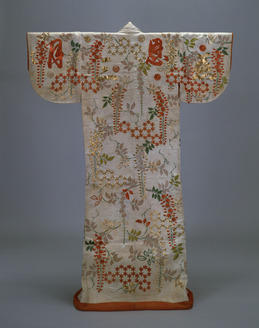
A kimono for a woman of the Fujiwara clan. It features geometric patterns reminiscent of the "Hon'iji" style and the floral motifs of the "Fujiwara-mon" and "Kame no Ita" styles, alternatingly arranged. The design is inspired by a poem by Hakkyo in "Wakan Rōeishū" (Upper Fuchū), titled "The Making…
<p>武家女性の打掛。藤の花房と亀甲文のような幾何学模様とを交互に配した「本辻【ほんつじ】」の打掛である。『和漢朗詠集【わかんろうえいしゅう】』(上・藤)にある白居易【はっきょい】の歌「悵望慈恩三月尽【じおんにちょうぼうすさんげつのつくることを】 紫藤花落鳥関関【しとうはなおちてとりかんかん】」をモティーフにする。漢詩の一部がデザインされ、持ち主の教養をうかがわせる。(小山弓弦葉氏執筆)<br /></p>
View the original at Japan Search →Article 2 defines a museum as an institution that collects, keeps and displays materials on history, art, folklore, industry and natural science for public use, carries out research on them, and which has been registered under Chapter 2 of this Act. The registration is not decorative. In law, an unregistered collection open to the public is not a museum.
The cool part. The definition of keeping is given as including raising. That single parenthesis is why a zoo, an aquarium and a botanical garden sit inside museum law in Japan: the collection is allowed to be alive. Article 1 also grounds the statute in the Social Education Act and the Basic Act on Culture and the Arts, which places museums in education first and culture second.
Verify at e-Gov 法令検索 →Use it Take the ratio, not the picture. It sets a page better than a grid does.
Description source: museum curator text, translated — not generated