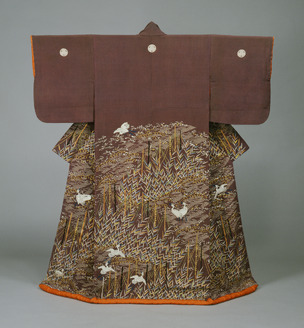
This is a small sleeve with intricate wrinkles, showing a water-edge pattern. Wave patterns are delicately white-dyed with thin lines, and the sleeve is adorned with colors such as mustard yellow, heron color, red, blue, and yellow threads, forming a bulrush pattern. A heron is also embroidered. A waist-band sleeve with three-leafed lotus design, white-dyed, was possibly brought by a maiden from the inner sanctum of the Tokugawa family temple.
細かい皺(しぼ)を出した絹織物である縮緬に水辺模様を表した小袖。波模様を細い線で白く染め上げ、萌黄(もえぎ)・鶸色(ひわいろ)・紅・藍(あい)・黄などの絹糸で葦模様を刺繡(ししゅう)。鷺も刺繡である。三つ葉葵紋を白く染め上げた腰下模様の小袖は徳川家の大奥から御殿女中が拝領したものか。
View the original at Japan Search →A craft cannot call itself traditional by taste or reputation. Article 2 sets five conditions, all of which must hold: it is used mainly in daily life, the main part of its making is by hand, it is made by traditional techniques, it is made chiefly from materials traditionally used, and a not-small number of people in a defined area still make it. The designation names the techniques, the materials and the region.
The cool part. Two conditions do quiet work. The first is daily use, so a technique kept alive only for display does not qualify. The fifth is the number of makers: the law will not protect a single surviving genius, because one person is a biography and not an industry. And because the region is written into the designation, the craft is legally attached to a place and cannot move.
Verify at e-Gov 法令検索 →Use it Two-colour foil on uncoated stock gets you most of this at production cost.
Description source: museum curator text, translated — not generated