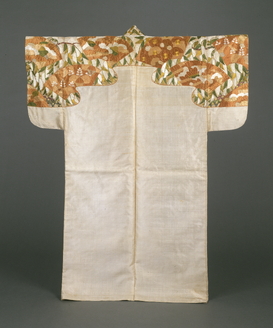
In a cleft called Jokito, where silk thread is used in abundance and intricately, there is a technique referred to as Rendodo. Silk threads are passed through in a scattered manner, creating patterns on the shoulders and hems. The design on the inside, filled with patterns, is called the shoulder-sleeve pattern. This style is typical of the Muromachi to Azuchimomoyama periods for small sleeves.
経糸(たて・いと)に生糸、緯糸(よこ・いと)に練絹糸を用いた練緯と呼ばれる裂(きれ)地に、絹糸をふっくらと渡した刺繡(し・しゅう)で模様を表わす。肩と裾に霞か雲のような区画を表わし、内側を模様で埋め尽くしたデザインは肩裾模様と呼ばれ、室町~安土桃山時代に典型的な小袖のスタイルである。
View the original at Japan Search →Japan implementing the 1970 UNESCO Convention. When a foreign state reports that cultural property has been stolen from an institution, the Ministry of Foreign Affairs notifies the education ministry, which designates the object as specified foreign cultural property, after consulting the trade ministry. Importing a designated object then requires approval under the foreign exchange and trade law.
The cool part. Article 6 quietly rewrites private law. Under the Civil Code a good-faith purchaser is normally secure against a recovery claim after two years. For designated stolen foreign cultural property, the victim may demand recovery from two years after the theft until ten years have passed. Buying in good faith does not settle the question for a decade, which is roughly how long it takes a stolen object to surface on a legitimate market.
Verify at e-Gov 法令検索 →Use it The border is the idea. Use it as an edge treatment and leave the centre empty.
Description source: museum curator text, translated — not generated