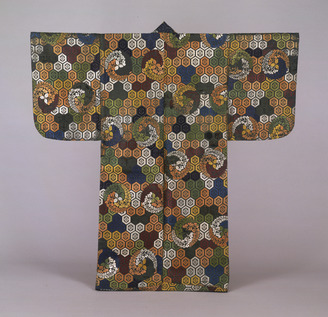
Tangoku refers to textiles with a historical name. Tangoku also refers to the formal attire for female roles (uwagi) that were created using such textiles. Dark colors such as purple and deep green were used as base colors. Geometric patterns like turtle crests and ginkgo leaves were arranged as motifs, while family crests and round crests were scattered as upper patterns. This design is a characteristic of the early Edo period.
唐織とはもともと織物の名称であるが、その織物でできた女性役の表着(うわぎ)のことも唐織と称する。紫や深い緑といった暗色を地色とし、地紋に亀甲紋や入子菱といった幾何学形模様を配し、家紋や丸紋といった上紋を散らしたデザインは、江戸時代初期の特徴である。
View the original at Japan Search →Article 1 describes the Ainu as the indigenous people of the northern part of the Japanese archipelago and of Hokkaido in particular, and cites international circumstances concerning indigenous peoples as a reason for acting. It requires the government to set a basic policy, and lets municipalities draw up regional plans for approval by the Prime Minister.
The cool part. The definition in Article 2 is the part to sit with. Ainu culture means the Ainu language, and the ways of living, music, dance, crafts and other cultural products inherited among the Ainu, and cultural products developed from these. That final clause refuses to freeze the culture at a date, and treats what is made next as equally the thing being protected. The Act then reaches into trademark law, reducing or waiving registration fees for regional collective trademarks used by approved projects.
Verify at e-Gov 法令検索 →Use it A motif small enough to blind-deboss, which is where restraint actually shows.
Description source: museum curator text, translated — not generated