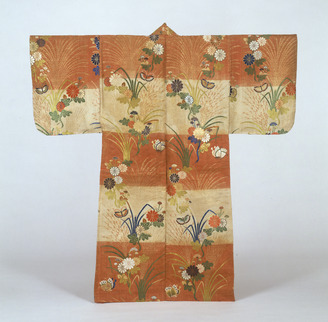
Tangaro is primarily worn during times when women take on leading roles. It is characterized by its lavish patterns created through a technique similar to embroidery called "fukidashi." When the character "ri no onna" (inner woman) appears in the foreground, she wears it in a simple, flowing style without bottom garments. Patterns combining autumn leaves and butterflies were favored for noble attire.
唐織は、主として女性役を演じる際の表着。刺繍のような風合いの縫取織による華やかな模様が特色である。前場のシテとして登場する「里の女」が着用する場合には、下に袴などをつけない「着流し」姿で登場する。秋草と蝶を組み合わせた模様は能装束に好まれた。
View the original at Japan Search →A craft cannot call itself traditional by taste or reputation. Article 2 sets five conditions, all of which must hold: it is used mainly in daily life, the main part of its making is by hand, it is made by traditional techniques, it is made chiefly from materials traditionally used, and a not-small number of people in a defined area still make it. The designation names the techniques, the materials and the region.
The cool part. Two conditions do quiet work. The first is daily use, so a technique kept alive only for display does not qualify. The fifth is the number of makers: the law will not protect a single surviving genius, because one person is a biography and not an industry. And because the region is written into the designation, the craft is legally attached to a place and cannot move.
Verify at e-Gov 法令検索 →Use it Palette for a single-colour run: one ink, heavy stock, nothing else on the sheet.
Description source: museum curator text, translated — not generated