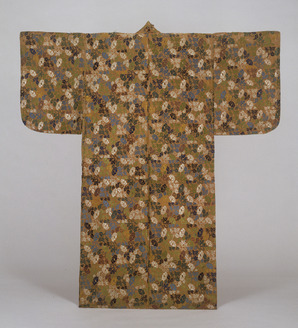
The term 'Tang' refers to Chinese textiles, but in actuality, these were woven and sewn in Japan during the Muromachi period. They have a characteristic appearance similar to embroidery. In the Edo period, they were mainly used as small sleeves for female roles on the Noh stage. For the role of 'Lady of the Interior' in Noh performances, they were worn over the flowing costume." Ruby: nuitoriori, shijū, kazurau.
「唐」つまり中国の織物という名称だが、実際には室町時代に日本で織られた縫取織で、刺繍のような風合いが特色である。江戸時代にはもっぱら能舞台で女性役を演じる際の小袖に使用された。鬘能の前シテである「里の女」を演じる際には着流しで着用する。 ルビ:ぬいとりおり ししゅう かづらのう
View the original at Japan Search →A statute built to coax privately held work onto public walls. An owner registers a piece with the Commissioner for Cultural Affairs, then contracts with a museum to display it. Article 2 defines a work of art broadly, as paintings, sculpture, crafts and other tangible cultural products that are movable, which is the legal way of saying anything you could carry out of the house.
The cool part. The terms are the interesting part. Article 2 requires the public display contract to run for five years or more, and to contain a clause stating that the parties may not give notice of cancellation. You cannot lend a masterpiece for the tax treatment and then reclaim it when the market turns. Japan concluded the barrier to seeing art was never storage. It was ownership, and the fix was a contract you cannot walk out of.
Verify at e-Gov 法令検索 →Use it Palette for a single-colour run: one ink, heavy stock, nothing else on the sheet.
Description source: museum curator text, translated — not generated