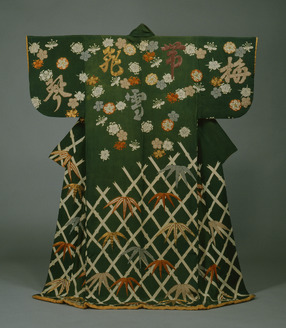
The design on the back features the characters "ume" (plum), "obi" (belt), "yuki" (snow), "hiji" (feather), and "koto" (samisen). The front displays the characters "ue" (above), "sakura" (cherry blossoms), "wa" (harmony), "kemuri" (smoke), and "sake" (alcohol). These characters were designed with the intention of embodying a poem from "Shohokuhou" (Chapter Shohou) of the Chinese Classic "Wen Han Lun Yi Ji" (Collection of Ten Thousand Poems): "Plum blossoms on the belt, snow falling, feather flying, samisen above, cherry blossoms in color, harmony in smoke, entering the sake." Therefore, various plum blossom patterns resembling snow crystals surround the characters.
背面に「梅」「帯」「雪」「飛」「琴」、前面に「上」「柳」「和」「煙」「酒」の文字をデザイン。『和漢朗詠集』の章孝標(しょうこうひょう)の漢詩「梅花帯雪飛琴上 柳色和煙入酒中」を意匠化したために、文字の周囲に雪の結晶を象ったようなさまざまな形の梅花模様が表される。
View the original at Japan Search →Japan implementing the 1970 UNESCO Convention. When a foreign state reports that cultural property has been stolen from an institution, the Ministry of Foreign Affairs notifies the education ministry, which designates the object as specified foreign cultural property, after consulting the trade ministry. Importing a designated object then requires approval under the foreign exchange and trade law.
The cool part. Article 6 quietly rewrites private law. Under the Civil Code a good-faith purchaser is normally secure against a recovery claim after two years. For designated stolen foreign cultural property, the victim may demand recovery from two years after the theft until ten years have passed. Buying in good faith does not settle the question for a decade, which is roughly how long it takes a stolen object to surface on a legitimate market.
Verify at e-Gov 法令検索 →Use it The border is the idea. Use it as an edge treatment and leave the centre empty.
Description source: museum curator text, translated — not generated