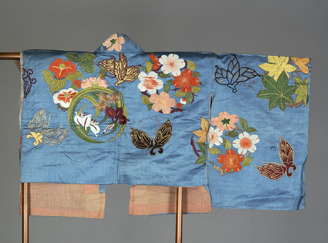
In front of the Renjou-in Temple of the Seikawa Lineage (Renshou-in), a "Kyoto Gonokumusume-dojoji" (Kyoto Gonokumusume-dojoji) was enacted, and one of the five panels of the lining of the robe used in this performance was found. It was decorated with a round emblem full of chrysanthemums, cherries, shoubu (perennial peonies), and momiji (maple leaves) in embroidery. The mon (crest) of the Sankai Miygasaki family from the area of Katsushika was depicted as a butterfly motif in the embroidery. Currently, the left sleeve is missing. 20100308_h09
細川蓮性院(れんしょういん)の前で演じられた「京鹿子娘道成寺(きょうがのこむすめどうじょうじ)」に用いられた5領の襦袢の内の1領。椿(つばき)・桜・菖蒲(しょうぶ)・紅葉(もみじ)といった花の丸紋をたっぷりとした刺繍(ししゅう)であらわし、坂東三津江の家紋である茗荷(みょうが)を象(かたど)った蝶模様を刺繍であしらう。現状では左袖が失われている。20100308_h09
View the original at Japan Search →Article 1 describes the Ainu as the indigenous people of the northern part of the Japanese archipelago and of Hokkaido in particular, and cites international circumstances concerning indigenous peoples as a reason for acting. It requires the government to set a basic policy, and lets municipalities draw up regional plans for approval by the Prime Minister.
The cool part. The definition in Article 2 is the part to sit with. Ainu culture means the Ainu language, and the ways of living, music, dance, crafts and other cultural products inherited among the Ainu, and cultural products developed from these. That final clause refuses to freeze the culture at a date, and treats what is made next as equally the thing being protected. The Act then reaches into trademark law, reducing or waiving registration fees for regional collective trademarks used by approved projects.
Verify at e-Gov 法令検索 →Use it The border is the idea. Use it as an edge treatment and leave the centre empty.
Description source: museum curator text, translated — not generated