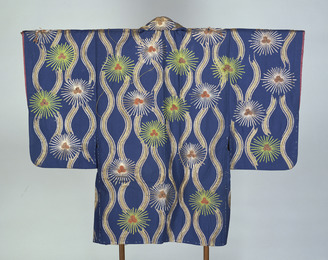
The second layer of "Hirakana Mongaku-ki," was used by Minamoto no Yoritsune. "Hirakana Mongaku-ki" is a work that simplified "Genpei Mongaku-ki" for common people. In the second layer, Minamoto no Yoritsune is infatuated with his sister, Chidori, while she is in love with his older brother, Yoritomo. He intends to protect the latter, who is late to the battle at Uji-gawa's front line.
「ひらかな盛衰記」の2段目、平次景高役に使用された衣装と伝わる。「ひらかな盛衰記」は「源平盛衰記」を庶民向けに脚色した作品。2段目では、兄・源太景季と相愛である腰元・千鳥に景高が横恋慕し、宇治川の先陣争いに遅れた兄をおとしめようとする。
View the original at Japan Search →A statute built to coax privately held work onto public walls. An owner registers a piece with the Commissioner for Cultural Affairs, then contracts with a museum to display it. Article 2 defines a work of art broadly, as paintings, sculpture, crafts and other tangible cultural products that are movable, which is the legal way of saying anything you could carry out of the house.
The cool part. The terms are the interesting part. Article 2 requires the public display contract to run for five years or more, and to contain a clause stating that the parties may not give notice of cancellation. You cannot lend a masterpiece for the tax treatment and then reclaim it when the market turns. Japan concluded the barrier to seeing art was never storage. It was ownership, and the fix was a contract you cannot walk out of.
Verify at e-Gov 法令検索 →Use it Two-colour foil on uncoated stock gets you most of this at production cost.
Description source: museum curator text, translated — not generated