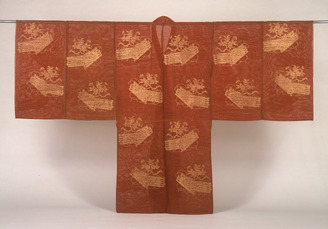
A woman's role-specific garment with sleeves for dancing. Made of thin materials such as silk and gauze, it features beautiful patterning with golden threads. The long sleeves create a graceful effect when raised during performance. It resembles the long robes worn by goddesses or other roles, but it has a collar that attaches to the neck and both sides are sewn shut.
舞を舞う女性役が着用する専用の上衣。絽(ろ)や紗(しゃ)などの薄物でできており金糸による華麗な織模様が特色。二幅の広袖は舞う際に翻り優雅な効果を生み出す。天女などの役が着用する長絹(ちょうけん)に似るが、衿(えり)の脇に衽(おくみ)がついており、両脇が縫い留められている点が異なる。
View the original at Japan Search →Japan implementing the 1970 UNESCO Convention. When a foreign state reports that cultural property has been stolen from an institution, the Ministry of Foreign Affairs notifies the education ministry, which designates the object as specified foreign cultural property, after consulting the trade ministry. Importing a designated object then requires approval under the foreign exchange and trade law.
The cool part. Article 6 quietly rewrites private law. Under the Civil Code a good-faith purchaser is normally secure against a recovery claim after two years. For designated stolen foreign cultural property, the victim may demand recovery from two years after the theft until ten years have passed. Buying in good faith does not settle the question for a decade, which is roughly how long it takes a stolen object to surface on a legitimate market.
Verify at e-Gov 法令検索 →Use it Two-colour foil on uncoated stock gets you most of this at production cost.
Description source: museum curator text, translated — not generated