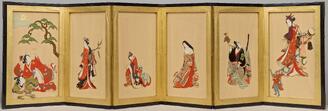
Extracted heavy paper and cotton, creating parts such as folds and pockets, which were then affixed to form a scroll painting. It can be considered a backdrop for a spontaneous summer kabuki theater production from the Edo period. The hairstyles of the heron-headed figures at the back, as well as the posture reminiscent of Suzuki Harunobu, suggest an antiquated representation.
くり抜いた厚紙と綿を、縮緬や金襴などの端切れでくるみパーツを作り、それらを貼り合わせた押絵による屏風。江戸時代、夏の吉原で催された即興芝居、俄を表したものと考えられます。後頭部に張り出した鶺鴒髱の髪型や鈴木春信風の姿から、懐古的に表したものでしょう。
View the original at Japan Search →A national statute written for one city. Article 1 recites the beauty of Kyoto and its historically, culturally and artistically important position in the world, and gives two purposes: to raise international culture and serve the ideal of permanent world peace, and to contribute to the economic recovery of Japan. It was passed five years after the war ended.
The cool part. Article 3 lets Kyoto designate culture tourism preservation districts and, by ordinance, prohibit building, rebuilding, removal, changes to the shape of the land and the cutting of bamboo, trees and stone, with compensation for ordinary loss. Then Article 4 does something statutes almost never do. It places a duty on the mayor personally: in the spirit of local autonomy, and with the cooperation of residents, the mayor must engage in ceaseless activity to complete the city. Nara received its own Act, number 250, the day before.
Verify at e-Gov 法令検索 →Use it Two-colour foil on uncoated stock gets you most of this at production cost.
Description source: museum curator text, translated — not generated