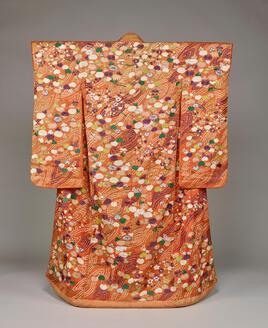
Kishu Tokugawa family of the 10th generation, in the Treasury of Reigan-in (Shishimai, Sonjoh, born 1765-1794) used it and passed it down. Due to its being a kimono sleeve, it is thought to have been used for a wedding. The design of women's formal clothing in the Buke (samurai) class features geometric patterns such as waves and weaving, as well as floral patterns. Ruby: Saya, Koaoi (2007/4/17_h081) (Revised 2009/6/24_h22)
紀州徳川家十代治宝室貞恭院(種姫 聡子 1765-1794)所用と伝わる。振袖であることから、婚礼用としてあつらえたものと考えられる。武家女性における正装のデザインは、流水形や紗綾形、小葵文といった幾何学形の模様と花束の模様が交互に表される。 ルビ:さや こあおい(2007/4/17_h081)(訂正20090624_h22)
View the original at Japan Search →A statute built to coax privately held work onto public walls. An owner registers a piece with the Commissioner for Cultural Affairs, then contracts with a museum to display it. Article 2 defines a work of art broadly, as paintings, sculpture, crafts and other tangible cultural products that are movable, which is the legal way of saying anything you could carry out of the house.
The cool part. The terms are the interesting part. Article 2 requires the public display contract to run for five years or more, and to contain a clause stating that the parties may not give notice of cancellation. You cannot lend a masterpiece for the tax treatment and then reclaim it when the market turns. Japan concluded the barrier to seeing art was never storage. It was ownership, and the fix was a contract you cannot walk out of.
Verify at e-Gov 法令検索 →Use it Take the ratio, not the picture. It sets a page better than a grid does.
Description source: museum curator text, translated — not generated